 Clinic
Review Article | DOI: https://doi.org/10.31579/2835-785X/097
Ancient Indian Science of Exercise Familiar with the Neighborhood
- Ven. Dr. Sumedh Thero *
Sumedh Bhoomi Buddha Vihar, Dr Ambedkar Park, Jhansipura, Lalitpur - 284403 India.
*Corresponding Author: Ven. Dr. Sumedh Thero, Sumedh Bhoomi Buddha Vihar, Dr Ambedkar Park, Jhansipura, Lalitpur - 284403 India.
Citation: Ven. Dr. Sumedh Thero, (2025), Ancient Indian Science of Exercise Familiar with the Neighborhood, International Journal of Clinical Research and Reports. 4(2); DOI:10.31579/2835-785X/097
Copyright: © 2025, Ven. Dr. Sumedh Thero. This is an open-access artic le distributed under the terms of the Creative Commons Attribution License, which permits unrestricted use, distribution, and reproduction in any medium, provided the original author and source are credited.
Received: 18 February 2025 | Accepted: 10 March 2025 | Published: 21 March 2025
Keywords: Ancient Indian Science; Yoga; meditation; happiness; stress
Abstract
Modern science authenticates that the practice of meditation, yoga and other kind of physical activities has touchable health benefits that include improved brain function and denser bones, as well as resistant health, better nervous system functioning and strength. Around the world, there are a lot of people, practice yoga meditation and enjoy the benefits of a calm mind, stronger body reduced stress and enlarged happiness. Yoga is beneficial for the health in ways that modern science is just beginning to understand. Although it has been applied with therapeutic intention for thousands of years, Yoga and physiotherapy are only just now emerging as a discipline in itself. More health care practitioners are starting to include these techniques in their approach to healing - and more trained teachers give a therapeutic intention to their teaching. As science begins to document the importance of understanding the interrelation of all existing things, it looks to Yoga with an intrigued eye, for Yoga speaks Unity in every word. As yoga techniques are researched and new data is gathered, it becomes easier for science and the medical establishment to understand and accept the benefit of meditation, yoga and other kind of physical Therapy.
Summary
Researcher of different allied discipline such as archeologist, epigraphy, genetics and historian reported that Indian civilization is the oldest civilization and cultural heritage in the world. Indian civilization started at last ten thousand years ago. The development of Vedic literature was started in the time of Indus valley civilization (Hindu civilization). Vyayama or Exercise is an importance practice of ancient India as per the evidence of Harappa civilization. Vedic text identified Vyayama is one of the very importance aspects in the human lifestyle. The objective of the present study was to explore the concept of Vyayama as explain in the famous Ayurvedic texts i.e., Caraka Samhita and Susruta Samhita. Ayurveda stated, Vyayama in an essential component for preventive, curative and rehabilitation medicine; given rejuvenation and longevity. This theoretical study was unfolding some fundamental concept of Vyayama as found in the age old authentic Ayurvedic literature. Ayurvedic literature supports the fact that Vyayama (exercise) culture was associated with ancient India. Caraka and Susruta Samhita strongly supported that Vyayama (exercise) is essential for a person to maintain his/her normal health and also prescribed it for prevention, cure and rehabilitation purpose (Bulti Roy and Mondal, 2016). It has mainly two aims i.e., protection and promotion of health and secondly cure from the diseases. According to Ayurveda Vyayama is an essential component for preventive health, rejuvenation and longevity (Bagde 2015).
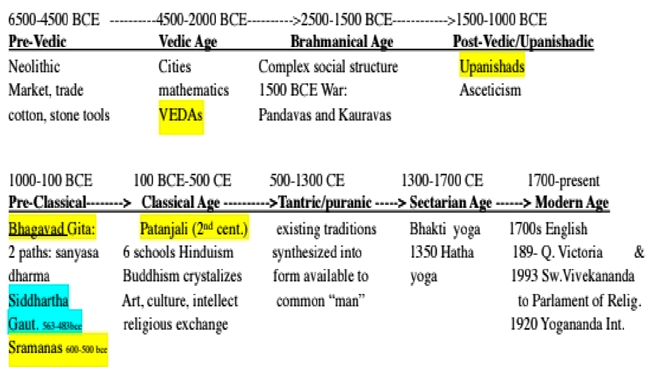
There are three renowned traditions of ancient classical Yoga discipline. These are the Hindu Yoga tradition of Patanjali (3 C.E.), the Jain Yoga tradition of Mahavira (600 B.C.E.) and the Buddhist Yoga tradition of the Gotama Buddha (623 B.C.E.- 543 B.C.E.). Each of these traditions has the common goal of happiness, or freedom from stress and suffering, through self-transformation. Each of these traditions achieves this goal through the gradual but persistent eradication of ignorance and delusion by using the method and practice advocated by its founder. Even though the teachings of the Buddha are not commonly referred to as Yoga, Feuerstein argues that the Buddhist practice falls under the framework of traditional Yoga. The goal of Buddhist practice is Nibbana or freedom from stress and suffering. This is accomplished through the practice of generosity (dana), virtue (sila), and tranquility and insight meditation (Samata and Vipassana bhavana). Buddhist Yoga is a process of voluntary selftransformation based on the teachings of the Gotama Buddha that leads to awakening or enlightenment and the resulting freedom from stress and suffering.
According to the Gotama Buddha the entire material universe (both animate and inanimate) was comprised of sub-atomic particles called kalapas, or indivisible units.14 These units exhibit in endless vibration the basic qualities of matter: mass, cohesion, temperature and movement. They combine to form structures that seem to have some permanence, but in fact, these miniscule kalapas are in a state of continuous arising and passing away, a state of continuous flux. As such, according to the Buddha, this body that we call “I” is comprised of an ever-changing flux of minute kalapas. The concept of no permanent self (anatta) is integral to the teachings of the Buddha. According to the teachings of the Buddha all conditioned and unconditioned phenomena is not self. This “being” that we call “I” is nothing but an aggregate of name and form (nama, rupa) that when analyzed breaks down to five fleeting components that change at incomprehensible speed. Along with the physical process: rupa, there is the mental process: the activities of the mind, nama. As the Buddha examined the body, He also examined the mind.15 He realized that the mind was comprised of four processes: consciousness (vinnana), perception (sanna), sensation (vedana), and volitional formations or responses (sankhara)
Then sensation arises. So long as input is not evaluated, sensation remains
neutral. But once the input has been evaluated, the sensation becomes pleasant or unpleasant depending on the evaluation. Because of ignorance and craving, if the sensation is pleasant, then a wish forms to prolong it. If the sensation is unpleasant, the mind responds by pushing it away, to stop it. With pleasant and unpleasant sensations, volitional response (sankara) occurs - the volitional response of the mind to prolong a pleasant sensation or to stop an unpleasant sensation. Only after a response has been repeated many times does awareness develop in the conscious mind. Some of these volitional responses lead to tanha; tanha for sense pleasures, tanha for the mistaken identity of a permanent I, and tanha for being. This leads to kamma, intentional unwholesome actions resulting from loba, dosa and moha and intentional wholesome actions resulting from the elimination of loba, dosa and moha, the deep-rooted identification with a permanent self, and at death, during the javana thought process, to rebirth consciousness. It is this transient nature of all phenomena that results in the First Noble Truth, the existence of suffering. All phenomena are anicca and anatta. Unaware of the cause of suffering; tanha to sense pleasures, tanha to the mistaken identity of a permanent self and tanha for being we grasp and cling to conditions that are forever changing with the hope of making them permanent. But in keeping with Dhamma all phenomena are anicca and anatta (transient) and as such dukka. The Buddha, observing at the deepest level of reality through insight meditation, realized that unmanaged volitional response (sankara) occurs because of ignorance and delusion. We are unaware of the fact that we respond and unaware of the real nature of that to which we respond. We are ignorant of the impermanent nature of all component phenomena and ignorant of the fact that volitional response builds to deep craving for being, the deep-rooted identity of a permanent “I” and that it leads to holding onto or averting sensations, which results in suffering. Not understanding our real nature, we respond blindly. Not knowing that we have responded, we persist in our blind responses and allow them to intensify. Thus, we become imprisoned in the habit of unmanaged volitional response (sankara) because of ignorance. The Buddha penetrated deep into His mind and body and realized ignorance was the root cause for rebirth consciousness, the mistaken identity of a permanent I and the stress and suffering caused by attachment to sense pleasures which He called the Doctrine of Dependent Arising (Paticca Samuppada) Digha Nikaya.
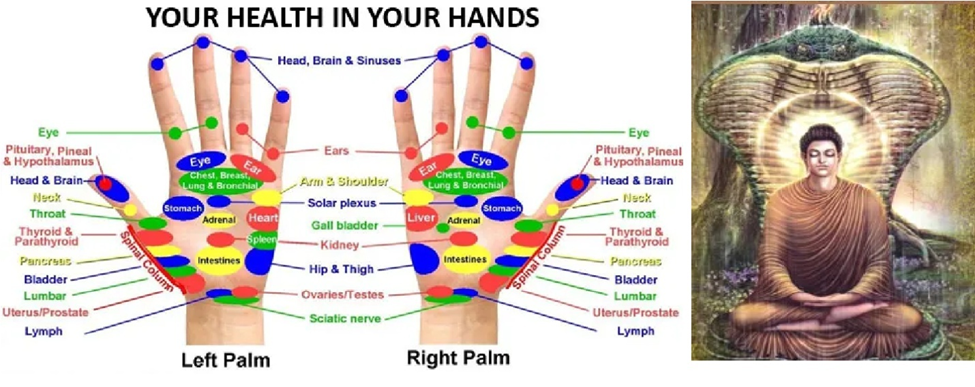
Yoga is an ancient Indian way of life that includes changes in mental attitude and the practice of specific techniques, such as postures, breathing patterns, and meditation, to attain the highest levels of consciousness (Taylor, 2010). Yoga is a psychosomatic spiritual discipline for achieving union and harmony between our mind, body, and soul and the ultimate union of our individual consciousness with the universal consciousness. When a person practices yoga with yogic attitude (patience, persistence, overcoming obstacles within self), there are several changes in physiology. It improves the sensibility of B cells in the pancreas to glucose signals and improves insulin sensitivity. Deep breathing patterns stretch lung tissues; this can synchronize neural elements with concomitant changes in the autonomic nervous system, reducing metabolism and stimulating the parasympathetic system. It can interact with autonomic centers and increase melatonin levels (Huang, 2017). Meditators have shown larger gray matter volumes and brain changes in areas involved with sensory, cognitive, and emotional processing. Meditators experience better QOL and functional health. During meditation heart rate, oxygen consumption and respiratory rate decrease in experienced practitioners. Meditators have also shown better scores in attention, concentration tasks, as well as fine coordinated movements; studies have shown positive effects in patients with respiratory disease and CVDs as well as diabetic patients and people with joint disorders. It can decrease indices of oxidative stress (Chan, 2016). It can reduce the metabolic rate by as much as 40% to 64%, which is within ranges of hibernating animals. A single 20-minute session of yogic breathing practice could reduce the levels of key proinflammatory biomarkers in saliva (Wang, 2016).
Before one starts Vipassana Meditation one needs to strengthen, develop and discipline the mind through tranquility (Samatha) Meditation. This is because, in general, our mind tends to run from one thing to another, out of control and contrary to our wishes. It is important then to begin by disciplining the mind so that it remains still without wandering. In the Buddhist tradition there are forty types (objects) of Samatha Meditation, which can be used for the development of the mind. The Buddha categorized human beings into six basic types or a combination of these six types - those with lustful temperament, those with hateful temperament, those with ignorant temperament, those with devout temperament, those with intellectual temperament, and those with discursive temperament. The appropriate Samatha Meditation was then selected to ensure optimum results by matching the type of meditation to the temperament of the yogi. The tranquility meditation that is most common in Buddhist practice is the awareness of breathing meditation or Aanapana Sati Meditation, which is what the Buddha Himself used to attain full awakening.
With the ongoing practice of tranquility Meditation, the yogi can now concentrate for longer periods of time and keep his mind focused throughout the entire period. One is also more aware of sensations. One will find that one is now aware of thoughts before they have been turned into speech or action. As such one can now concentrate with Right Effort as laid out in the Noble Eightfold Path; the Buddha's Path to Nibbana, as one now has better control or discipline of one's mind.19 One can now: Prevent evil or unwholesome thoughts from arising Abandon evil or unwholesome thoughts if they should arise Generate wholesome and good thoughts that have not arisen Develop and bring to fruition good and wholesome thoughts that have arisen Meditation is now moving from the "classroom" to one‟s daily life. One begins to be mindful in every thought, action and speech. Whether one eats, or reads, or drives, or studies, one does it mindfully. One is fully aware of what one is doing. When one engages in more than one activity at a time, it is difficult to be mindful of either one of the activities. But with meditation this slowly changes. One is now aware and mindful and practicing Right Mindfulness as laid out in the Noble Eightfold Path. One is mindful of: Activities of the body Sensations or feelings Activities of the mind Ideas and thoughts by maintaining this awareness for as long as possible one develops Right Concentration. The Buddha said that, everywhere within the body one experiences sensation. Wherever there is life there is sensation. If you allow the attention to move at random from one part of the body to another, from one sensation to another, naturally it will always be attracted to the areas where there is strong sensation.
For us, in our daily life, each time we try to discipline our minds to reduce craving that leads to clinging and aversion through the practice of generosity and virtue we reduce suffering. At this point we are trying to discipline sankhara that cause craving that leads to loba and dosa, as opposed to the sankhara that cause craving for being and the mistaken identity of a permanent self. The state of Nibbana, however, eradicates all sankhara produced through ignorance. As such the practice of tranquility and insight meditation that is overlaid on a strong foundation of generosity and virtue completes the Noble Eightfold Path, the Buddha‟s path to Nibbana. The volitional responses arise only because of our ignorance of our true nature. Resulting from this ignorance, the three roots from which suffering arises are greed, hatred and delusion. Nibbana, the destruction of suffering, is then the eradication or the total destruction (and the resulting absence) of greed, hatred and delusion.
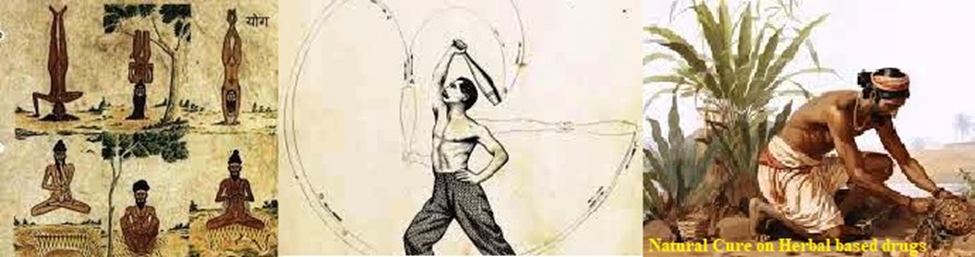
There are too many misconceptions clouding the science of Yoga. People recognize it to be some kind of black or white magic, sorcery, physical or mental debauchery through which miraculous feats can be performed. For some it is a very dangerous practice which should be limited to only those who have renounced the world. There are few others think it to be a kind of mental and physical acrobatics that is compatible only to a Hindu mind. More than 5,000 years ago, yoga started its journey as an ancient Indian science of exercise and healing, passed along from teacher to student through oral tradition and physical practice. Yoga is also famous as one of the oldest holistic health care systems, not just because of its fundamental healing approach, but also because of its many benefits for physical, mental and spiritual well-being. Buddhism adopted certain yogic practices even in its nascent stages. Buddha is said to have lived in India between 563 and 483 BCE. Buddhism proposes that all worldly suffering can be alleviated if one renounces the material world. The yogic tradition, with its focus on the inner self, was hence adopted by Buddhism. The common essence of both yoga and Buddhism is the attainment of enlightenment through discipline. Buddhism refers to this enlightenment or realisation as Nirvana. While the history of yoga goes far back in time, the physical aspects of the yogic practice were first detailed by sage Patanjali between 400 and 500 CE. The sage was a scholar of the Hindu belief system, and he elaborated on the transcendental aspects of the yogic theory. His work, the Yoga Sutras, is widely known for the information it contains about asanas or the physical component of yoga centered around postures.
There is evidence, that Buddha Shakyamuni himself practiced yoga and taught about it, so yoga is traditionally part of the Buddhist teachings. After his ordination the Buddha spent six years on a river called Narentsana, near Bodhgaya. There he practiced a form of yogic asceticism, during which he subsisted merely on a grain of rice and a drop water per a day. Some might now object that this is not really yoga, since neither arms nor legs are moved. In the following I will go into a little more detail about this. Buddha was focused at that time on mind training, for which he had received instructions from various teachers. At the same time, he was practicing the meditations of calm abiding and clear insight. Through this he finally realised the true nature of phenomena, their inherent emptiness and how they appear through dependent arising. After having attained enlightenment, he began to teach and turned the wheel of Dharma three times, as it is said. He also gave explanations of yogic practice (Dolpo Tulku Rinpoche, 2011). There are two types of Buddha's teachings that have survived: the Sutra1 and the Tantra2 teachings. In the Sutras it is described, for example, in which way the breath is used as support for the meditation of calm abiding, which is considered a form of yoga. These breathing exercises are called Pranayam in Sanskrit, and within Buddhism are practiced by the listeners (Shravakas), the self-realising Buddhas, and by the Bodhisattvas. Within the secret Mantrayana, the Buddha’s tantra teachings, we speak of three levels of yoga practice: Mahayoga, Anuyoga and Atiyoga. Here the word yoga is already integrated in the name. In Mahayoga the main focus lies on breathing exercises in connection with the inner wind or energies and the inner channels; in Anuyoga the focus is placed on the exercises of the inner essence drops, and in Atiyoga, also called Dzogchen, it is primarily about bringing out our primordial wisdom based on the breathing practice and the exercises of the inner channels.
Yoga and Buddhism are both meditation traditions devised to help us transcend karma and rebirth and realize the truth of consciousness. They see the suffering and impermanence inherent in all birth, whether it is animal, human or God, and seek to alleviate it through developing a higher awareness. Both emphasize the need to dissolve the ego, the sense of the me and the mine, and return to the original reality that is not limited by the separate self. Both traditions emphasize enlightenment or inner illumination to be realized through meditation. Both systems recognize dharma, the principle of truth or natural law, as the basic law of the universe we must come to understand. Such dharmas are the law of karma and the unity of all sentient beings. Buddhism defines itself as Buddha dharma or the dharma of the enlightened ones, which is seen as a tradition transcending time or place. Yoga defines itself as part of the Hindu tradition called Sanatana Dharma, the universal or eternal dharma, which is not defined according to any particular teacher or tradition. Both traditions have called themselves Arya Dharma or the Dharma of noble men.
The Sandhinirmochana-sutra is divided into eight sections, including an introduction in the classical style. As in the case of all universalist Buddhist scriptures, the introduction to this text is an important part of the work, making preliminary presentations of key principles and practices in a highly concentrated setting, partly symbolic and partly literal. The seventh section of the course deals with the ten transcendent ways and ten stages of enlightenment, which are comprehensive outlines of Buddhist Yoga. Thus, the scripture concludes the course with an intensive recapitulation of the sphere of knowledge and action of the enlightened (Sutrapitaka. 1995).
Buddhist Yoga … presents a typically detailed analysis of the qualities, capacities, and domains of operation that characterize a Buddha, or a fully enlightened mind. Here the critical distinction is drawn between liberation and enlightenment, the latter referring to the total sublimation and completion of the individual. The completion is made possible by liberation, but liberation alone does not of itself bring completion. Thus, the scripture concludes the course with an intensive recapitulation of the sphere of knowledge and action of the enlightened.” Buddhist philosophers and meditators are generally not primarily concerned with learning about other topics (e.g., history, geography, etc.) that are not perceived as being relevant to this soteriological orientation. Rather, Buddhist texts are considered to be important insofar as they reveal something about human existence and how human beings can realize their highest potential through attaining the state of Buddhahood (John Powers 1993). The core practice of meditation (Vipassanā) involves mindfulness in four domains: mindfulness of the body (kāyānupassanā), mindfulness of feelings (vēdanānupassanā), mindfulness of the mind or consciousness (cittānupassanā), and mindfulness of phenomena or Dhamma (dhammānupassanā). As practitioners engage in Vipassanā, they must continually observe their sensory experiences to prevent cravings from arising, as these cravings can fuel future cycles of rebirth.
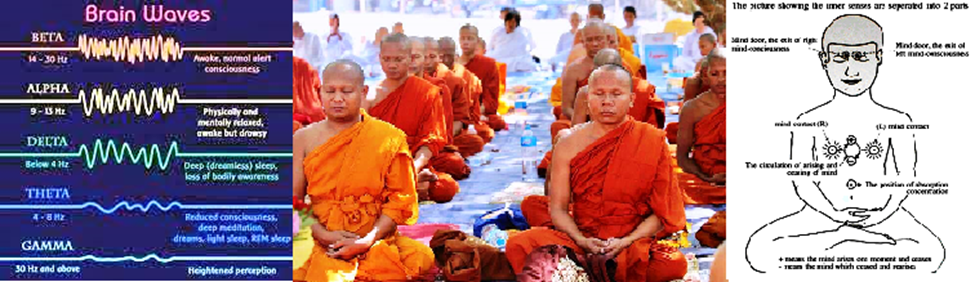
Brain generates beta waves when it is actively engaged in mental activities. Beta brain waves have a relatively low amplitude and are one of the fastest of the five types of brain waves. Only gamma waves are faster. Beta's frequency varies from about 14 to 35 Hz. Beta waves remain as normal thinking state. It reflects the active thought processes that brain waves experience from day-to-day life. Thus, in the meditation stage/process body get controlled by beta waves, as it functions in the world, to think logically, solve problems and confront whatever is happening out there.
In addition to such considerations, this study has attempted to provide a speculative overview of the way in which the Samdhinirmocana attempted to influence power relations and some examples of how it succeeded in doing so. This aspect of the study has implications for contemporary philosophical studies as well, since it seems probable that much of the history of philosophy in any culture reflects changing power relations. Those who are successful are those who have an impact on subsequent thought and power relations. Their texts restructure the rules of debate for successive generations of thinkers and their traditions are able to influence the interpretation of texts of their own schools and sometimes those of rival factions. Systematic review and meta-analysis provide evidence that either yoga or walking has positive effects on glycemic control and insulin resistance in comparison to the control group (no regular exercise) in patients with type 2 diabetes taking oral hypoglycemic agents. The change of HbA1c and FBG in the walking group compared to the control group is statistically significant but may not be clinically significant. Comparatively, yoga has more significant effects on glycemic control and insulin resistance in comparison to walking for the management of type 2 diabetes (Biswajit Dhali, et al 2023).
References
- Bagde AB. 2015 Preventive Aspect of Vyayama (Physical Exercise). International Journal of Ayurveda & Alternative Medicine. 2015; 3(1):7-10, ISSN 2348-0173.
View at Publisher | View at Google Scholar - Biswajit Dhali, Sridip Chatterjee, Sudip Sundar Das, Mary D Cruz. 2023. Effect of Yoga and Walking on Glycemic Control for the Management of Type 2 Diabetes: A Systematic Review and Meta-analysis. the ASEAN Federation of Review Article Endocrine Societies. Vol. 38 No. 2 November 2023 www.asean-endocrinejournal.org
View at Publisher | View at Google Scholar - Bulti Roy and Samiran Mondal 2016.Vyayama culture in ancient India. International Journal of Physical Education, Sports and Health 2016; 3(6): 332-333
View at Publisher | View at Google Scholar - Carlos E. Rivera-Tavarez 2017. Alternative Treatment Modalities and Its Effect in Older Populations. Phys Med Rehabil Clin N Am 28 (2017) 671–680 http://dx.doi.org/10.1016/j.pmr.2017.06.002
View at Publisher | View at Google Scholar - Chan A.W. Tai chi qigong as a means to improve night-time sleep quality among older adults with cognitive impairment: a pilot randomized controlled trial Clin Interv Aging (2016)
View at Publisher | View at Google Scholar - De Graff, Geoffrey (2002). Handfull of Leaves I, (An Anthology from the Digha and Majjhima Nikayas), U.S.A. The Sati Centre for Buddhist Studies and Metta Forest Monastery
View at Publisher | View at Google Scholar - Digha Nikaya 22 (The Great Frames of Reference Discourse)
View at Publisher | View at Google Scholar - Dolpo Tulku Rinpoche, 2011. Yoga in Buddhism Lecture held at 3-Klang-Studio, Buckenhof-Erlangen, 1st November 2011 https://www.dolpotulku.org/wp-content/uploads/2024/01/TL_YogaInbuddhism-2011_.pdf
View at Publisher | View at Google Scholar - Huang Z.-G. Systematic review and meta-analysis: tai chi for preventing falls in older adults BMJ Open (2017)
View at Publisher | View at Google Scholar - John Powers 1993. HERMENEUTICS AND TRADITION IN THE Samdhinirmocana-sütra. BUDDHIST TRADITION SERIES 1993 BYE.J. BRILL, LEIDEN, THE NETHERLANDS. ISBN: 81-208-1926-8
View at Publisher | View at Google Scholar - Rahula, Walpola (1989). What the Buddha Taught. London, England: Gordon Fraser Gallery Ltd.
View at Publisher | View at Google Scholar - Stoler Miller, Barbara (1998). Yoga Discipline of Freedom, USA: Bantam Books
View at Publisher | View at Google Scholar - Sutrapitaka. 1995. Samdhinirmocanasutra. Tripitaka. English. Buddhist yoga: a comprehensive course/translated by Thomas Cleary. —1st ed. p. cm. ISBN 1-56957-106-6 I. Cleary, Thomas.
View at Publisher | View at Google Scholar - Taylor- R.E. Piliae . Effects of tai chi and Western exercise on physical and cognitive functioning in healthy community-dwelling older adults J Aging Phys Act (2010)
View at Publisher | View at Google Scholar - Wang X.Q. Traditional Chinese exercise for cardiovascular diseases: systematic review and meta-analysis of randomized controlled trials J Am Heart Assoc (2016)
View at Publisher | View at Google Scholar - Whicher Ian (1998). The Integrity of the Yoga Darsana, USA: State University of New York Press.
View at Publisher | View at Google Scholar