 Clinic
Case Report | DOI: https://doi.org/10.31579/2835- 8295/143
Metamorphic Visual Hallucinations in a Patient with Bipolar I Disorder: A Case Report
Sultan Akbar, Mohamed Ramadan, Leonard B. Goldstein
University Mesa, Arizona and A.T. Still University, Mesa, Arizona, USA
*Corresponding Author: : Leonard Goldstein, University Mesa, Arizona and A.T. Still University, Mesa, Arizona, USA
Citation: Aidan T.R MPH., Sean P., Vanessa G., Leonard Goldstein., (2026), Metamorphic Visual Hallucinations in a Patient with Bipolar I Disorder: A Case Report”, International Journal of Clinical Reports and Studies, 5(1); DOI:10.31579/2835- 8295/143
Copyright: © 2026, Leonard Goldstein. This is an open-access artic le distributed under the terms of the Creative Commons Attribution License, which permits unrestricted use, distribution, and reproduction in any medium, provided the original author and source are credited.
Received: 20 November 2025 | Accepted: 26 December 2025 | Published: 06 January 2026
Keywords: hallucinations; quetiapine; bipolar disorder; psychosis; sertraline; antipsychotics; mood stabilizers
Abstract
Hallucinations can be caused by a number of etiologies. They can cause a patient significant distress and markedly interfere with a patient’s ability to socialize and work. When a patient is experiencing hallucinations, it is important to get them under control and correctly identify the underlying cause. We present the case of a patient with bipolar 1 disorder who had a concrete understanding of shapeshifting friends of his that could communicate to him, but kept these powers secret from the rest of the world. He also reported the ability to receive messages spontaneously in his mind to make various decisions. Upon further inspection he had a significant past medical history which raises questions on what exactly is causing these symptoms of his despite complying with pharmacotherapy.
Introduction:
Bipolar disorder is characterized by chronically occurring episodes of mania or hypomania alternating with depression and is often misdiagnosed initially (1). Currently, the etiology of bipolar disorder is unknown but appears to be due to an interaction of genetic, epigenetic, neurochemical, and environmental factors (1). Surprisingly, diagnosis and optimal treatment are often delayed by a mean of approximately 9 years following an initial depressive episode (2). Long-term treatment consists of mood-stabilizers such as lithium, valproate, and lamotrigine. Antipsychotic agents such as quetiapine, risperidone, aripiprazole, and lurasidone are typically added (2). More than 50% of patients with bipolar disorder are nonadherent to treatment (2). A significant number of patients with bipolar disorder experience hallucinations (3). Compared with patients diagnosed with schizophrenia, hallucinations among patients with bipolar disorder have been found to be less severe, more visual and less often auditory (3).
This article will present the case of a patient with type 1 bipolar disorder who reported being able to see shapeshifting humans and receive supernatural communications that could guide him.
Case Presentation:
Nicholas was a patient with type 1 bipolar disorder that presented to the clinic for a medication reconciliation. He had several comorbid illnesses requiring treatment as well. He was very eager to explain his ability to receive messages from an external entity which would guide his decision making and also his shapeshifting friend. He was at the store months prior and past a female who was also shopping. He received a strange message from this external entity that left him confused. He then went to his car and received a phone call from his mother. After he got off his phone, he received a message from this entity that the phone call from his mother was to prompt him to return to the store and speak to the woman who was shopping. After doing so, it turned out that this girl also had the same ability and they then became friends.
Figure 1: Mania Rating Scale
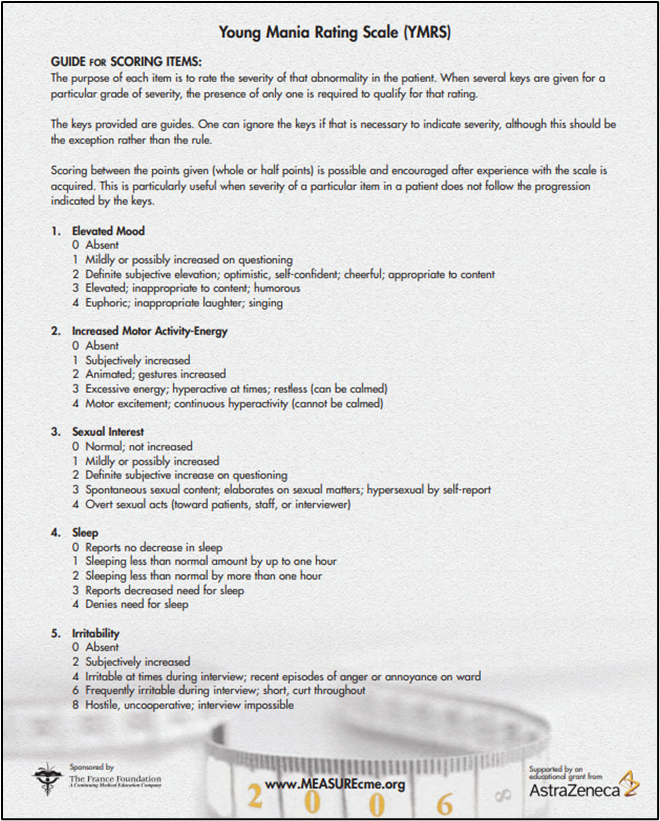
Figure 1: Figure 1 showcases the Young Mania Rating Scale used to determine the severity of mania in a patient with bipolar disorder (3).
He then proceeded to discuss his shapeshifting friend that he met off of facebook. His friend has the ability to shapeshift into various animals such as a lion or tiger of various colors. This happens both when they are in person and video calling. He reports a video call between the two in which he had a person at his home that was trying to peer at his friend who had shapeshifted into a lion. Just in time his friend was able to return to a human state and insisted that Nicholas make sure to keep his abilities a secret.
Throughout the appointment, Nicholas insisted that all of his experiences were true and that there are numerous worlds that are unseen. He relates his experiences as different perspectives of an objective reality. He equates his alternate sensory experiences to the wave-particle duality of light in the sense that he has a different angle to understand something that is objective.
Throughout his life he spent a total time in jail less than two months and was currently on probation. Growing up, he was subject to sexual, physical, and emotional abuse. He also had 3 inpatient psychiatric hospitalizations and was attempting to detox from alcohol. He had attempted suicide once by putting a knife or a razor to his throat. At a point in time, he was attempting to “macrodose” psilocybin mushrooms for medicinal purposes.
He reports that he is taking all of his medications as prescribed. On a mental status examination, he is found to have an impaired mental status with disorganized thinking. Otherwise, he had no depression, suicidal ideation, or homicidal ideation. He was entirely content with these experiences of his and had no outstanding complaint to be addressed at the appointment.
Discussion:
Nicholas’ reports seemed to be consistent with hallucinations. There are numerous causes of hallucinations and Nicholas’ medical history was quite significant. While he had already received the diagnosis of type 1 bipolar disorder with psychotic features he had numerous factors in his medical history that could lead to these symptoms. One of which was history of physical, emotional, and sexual abuse during his childhood. Another potential cause could be long-term consequences of his psilocybin mushroom usage which he “macrodosed.” An alternative explanation for his symptoms could be that each of these factors could have accumulated to result in his symptoms.
Conclusion:
A patient presenting with hallucinations can sometimes be difficult to understand. Hallucinations can be caused by a variety of etiologies and a substantial investigation must be done. It is crucial for the provider to carefully review the patient’s medical history and ask relevant questions to hone in on the patient’s diagnosis.
Statement of Informed Consent:
Informed consent was obtained from the patient that was presented in the case report.
Conclusion:
A patient presenting with hallucinations can sometimes be difficult to understand. Hallucinations can be caused by a variety of etiologies and a substantial investigation must be done. It is crucial for the provider to carefully review the patient’s medical history and ask relevant questions to hone in on the patient’s diagnosis.
Statement of Informed Consent:
Informed consent was obtained from the patient that was presented in the case report.
References
- Jain, A.; Mitra, P. (2023). Bipolar Disorder. In: StatPearls [Internet]. Treasure Island (FL): StatPearls Publishing; updated February 20.
View at Publisher | View at Google Scholar - Nierenberg, A. A.; Agustini, B.; Köhler-Forsberg, O.; Cusin, C.; Katz, D.; ET ALL., (2023). Diagnosis and Treatment of Bipolar Disorder: A Review. JAMA; 330(14): 1370-1380.
View at Publisher | View at Google Scholar - Baethge, C.; Baldessarini, R. J.; Freudenthal, K.; Streeruwitz, A.; Bauer, M.; et all., (2005). Hallucinations in Bipolar Disorder: Characteristics and Comparison to Unipolar Depression and Schizophrenia. Bipolar Disorders; 7(2): 136–145.
View at Publisher | View at Google Scholar - Young RC, Biggs JT, Ziegler VE, Meyer DA: “The Young Mania Rating Scale (YMRS) – Measure with Background”
View at Publisher | View at Google Scholar