 Clinic
Research Article | DOI: https://doi.org/10.31579/2835-785X/119
Human Body Cells Reflected in A Number of Collectibles
Department of Medical and Biological Foundations of Sports and Physical Rehabilitation, The Petro Mohyla Black Sea State University, Nikolaev, Ukraine.
*Corresponding Author: Dr. Konstantin Anatolyevich Bugaevsky, Department of Medical and Biological Foundations of Sports and Physical Rehabilitation, The Petro Mohyla Black Sea State University, Nikolaev, Ukraine.
Citation: K.A. Bugaevsky, (2026), Human Body Cells Reflected in A Number of Collectibles, International Journal of Clinical Research and Reports. 5(1); DOI: 10.31579/2835-785X/119.
Copyright: © 2026, Dr. K.A. Bugaevsky. This is an open-access article distributed under the terms of the Creative Commons Attribution License, which permits unrestricted use, distribution, and reproduction in any medium, provided the original author and source are credited.
Received: 07 January 2026 | Accepted: 16 January 2026 | Published: 28 January 2026
Keywords: human cells; human tissue; collecting tools; philately; philocarty; phaleristics; numismatics; screenshot copies
Abstract
In this new research article, the author presents the results and analysis of his new research, which is thematically devoted to the study of the issue of the representation of a wide variety of cells and, in part, human tissues (bone and muscle tissue), in relation to a number of collecting methods, such as philately, numismatics, philocarty and phaleristics, in all their diversity.
Aim of the article
The purpose of the conducted research and the subsequent writing by the author, based on its results and analysis, of this thematic research article, is the author’s desire to present the results obtained by him and their critical analysis, in relation to the representation of the most diverse collection materials dedicated to the cells and tissues of the human body, in such means of collecting as: philately, philocarty, phaleristics and numismatics.
Introduction
To be fair, it should be noted that the topic explored by the author is not very popular, reflected in collecting media, and collection materials on this subject are limited [1-6]. Nevertheless, as a result of extensive, painstaking research, the author of this study was able to gather the necessary quantity and variety of collection materials for this article, which he now presents to his readers.
Hypothesis of the article
During the planning of this study, its author put forward the hypothesis that there might exist a certain number of very diverse collection materials thematically dedicated to the cells and tissues of the human body.
Method and materials of the study
In conducting this study and writing the obtained materials, their analysis and subsequent presentation in his research article, the author used the following research methods: study and literary-critical analysis of available materials on the issue studied by the author; searching and selecting on the Internet the necessary illustrative and textual materials, thematically devoted to collecting philatelic and numismatic materials, dedicated to various aspects of human body cytology, in all its diversity - in particular in specialized articles by collectors of various orientations, thematically devoted to the issue studied. Also, the author of this study performed a painstaking analysis and sorting of these obtained materials; transformation, with the help of special computer programs, of the found collection materials into their color and/or black and white screenshot copies; the formation of a short, accompanying text for the illustrations selected by the author and the content of the text itself, this completely new, original research article.
Results of the study and discussion
At the very beginning of this author's research article, I would like to begin with the presentation of general, introductory information about the most diverse cells of the human body, which is supplemented by illustrative, visual materials [5, 6].
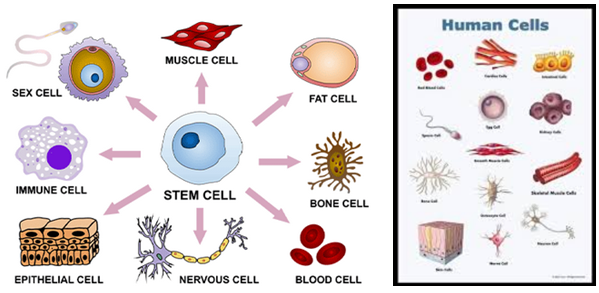
Figure 1. Schematic representation of different types of cells in the human body.
I would like to present my presentation of the text and illustrative material obtained during this study, with materials dedicated to various cells, both "white" and "red" blood, as reflected in such collecting tools as philately - postage stamps and envelopes of different countries of the world and the years of their issue [6-14], and in the means of phaleristics, on thematic badges. Most often, philately presents images of both physiological samples of blood cells, on its smears, and samples of blood cells in various variants of its pathology, most often - in malaria, together with plasmodia of malarial or other infection, as well as in such a pathology as sickle cell anemia. Thematic Figure 2 presents these samples of similar philatelic materials, as well as a representation of bone marrow cells [6-14].
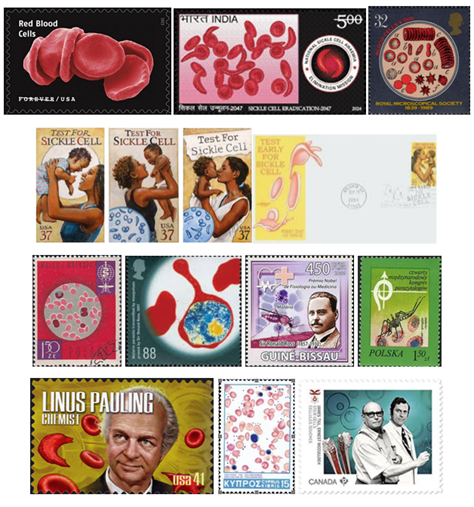
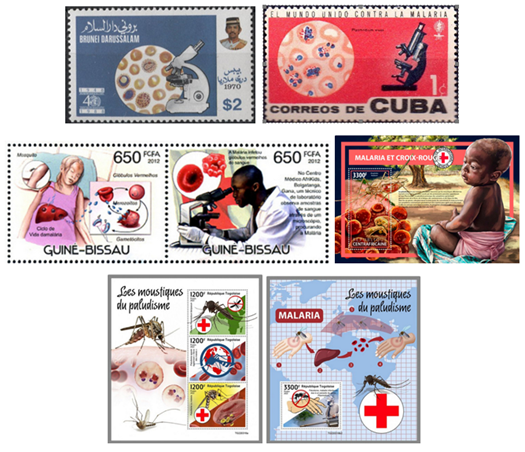
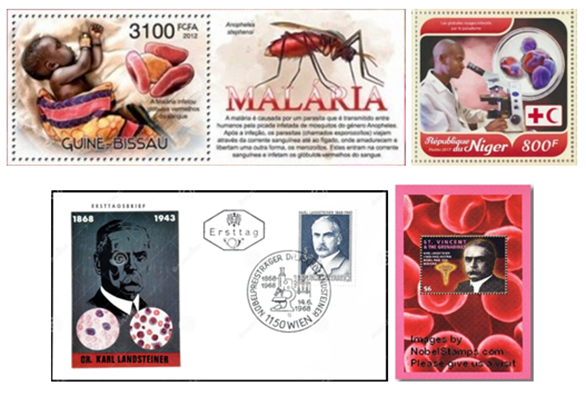
Figure 2. Blood cells, in normal conditions and in a number of different pathological conditions, as reflected in philatelic means.
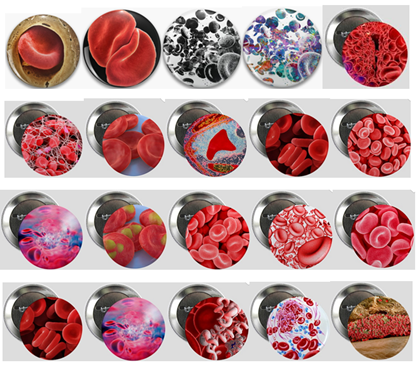
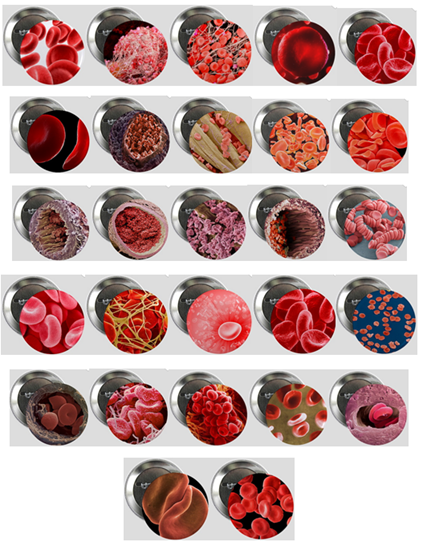
Red and white blood cells are particularly widely represented in phaleristics, on thematic icons [6-15]. First, in thematic figure 3, icons will be presented depicting erythrocytes, both individually and in the lumen of blood vessels, and sometimes together with hemoglobin molecules [6-15].
There are also thematic icons with images on their front side of both erythrocytes and leukocytes/cells of “white” blood, as well as a number of other formed elements of the blood and – in leukemia – which are presented in a new thematic, phaleristic collection, in Figure 4 [6-15].
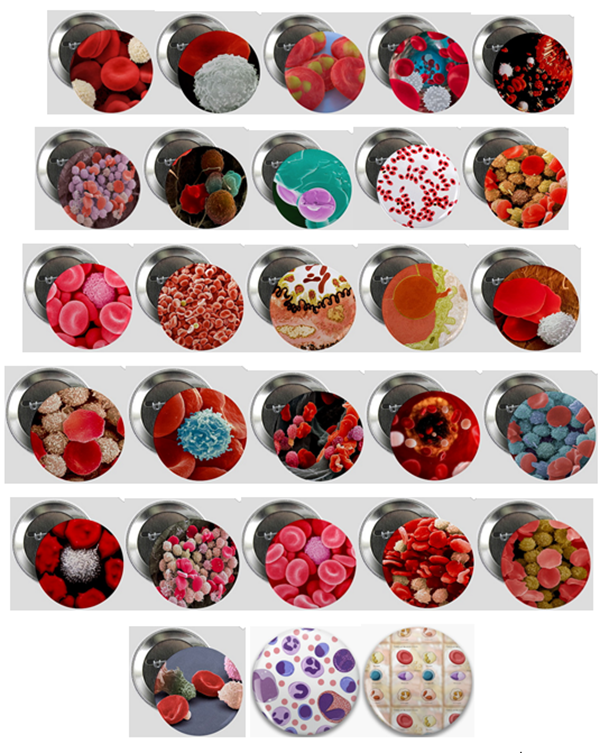
Figure 4. White and red blood cells on thematic badges.
There are also images of human blood cells, in a type of collection known as philocarty - on thematic, educational cards. For example, thematic Figure 5 features such cards, depicting a type of white blood cell called a neutrophil, as well as red blood cells, both in normal conditions and in various pathologies [16-25].
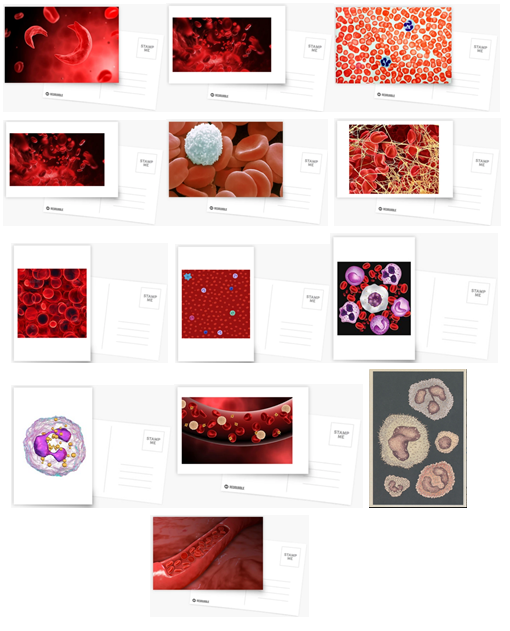
Figure 5. Human blood cells reflected in the phylocarty on postcards.
Further, in Figure 6a, b, c, thematic collectible, philatelic (postage stamps, first day covers), numismatic (table commemorative medals), and phaleristic (thematic badges) materials are presented on which human and mouse nerve cells are represented/depicted [25-27].
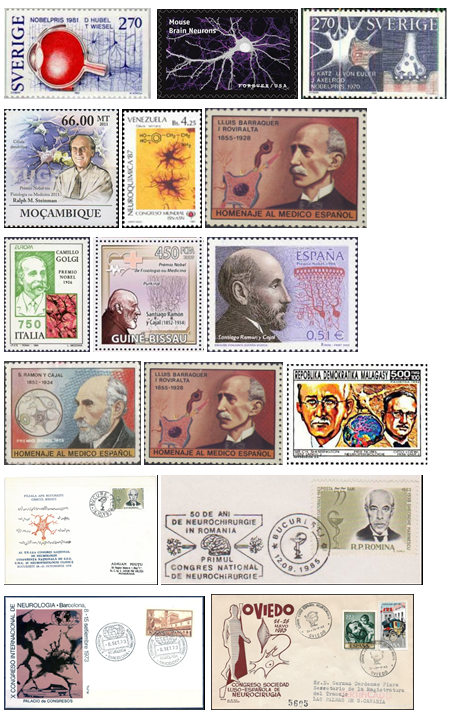
Figure 6A. Philatelic collection, thematically dedicated to nerve cells.
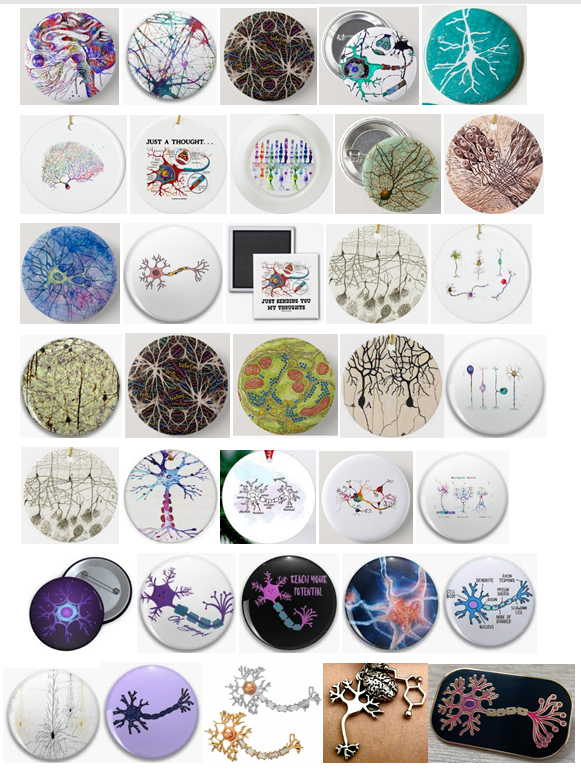
Figure 6B. A selection of thematic badges and broshes depicting nerve cells
The following figure 6c shows a rather interesting, thematic, numismatic collection of bronze and silver commemorative table medals dedicated to the image of nerve cells on their reverse, and portraits of world-famous neurologists, Nobel Prize laureates, such as, in particular, the Italian scientist Camillo Golgi (1843-1926) and the Portuguese scientist Santiago Ramon Y Cayal (1852-1934). Also, in the same figure, a commemorative coin of Cyprus (2020), with a denomination of 2 euros, with an image of a human nerve cell on its reverse is shown [28-36].
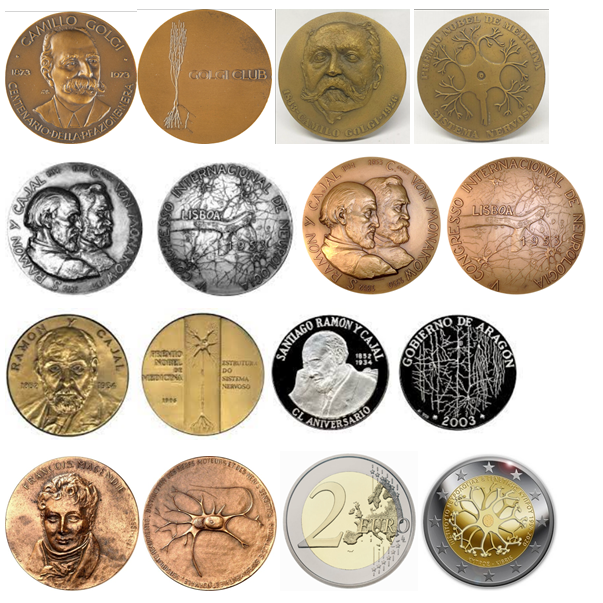
Figure 6C. A numismatic collection of commemorative table medals depicting nerve cells and famous neurologists.
Continuing my story about the various cells of the human body, in the reflection of a number of collecting tools, I would like to present, in thematic figure 7, postage stamps (philately) and thematic badges (phaleristics), dedicated to the largest cell of the human body - the egg, both primary and at different stages of its development and transformation, as well as the male reproductive cell - the sperm [37,38].
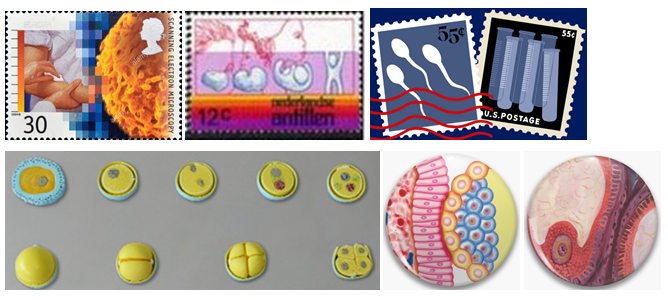
Figure 7. A selection of a number of collection materials, with images of an egg cell at different stages of its development and a sperm cell.
Further, in thematic figure 8, thematic bafges and a postage stamp are presented, with images of cells of the bone (osteoclasts) and muscle systems of the human (myocytes) [11-14, 39].
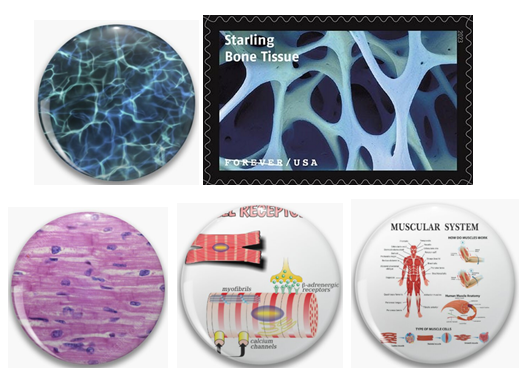
Figure 9. Phaleristic selection of thematic badges depicting the anatomy and histology of human skin.
This concludes another author's research article devoted to the thematic, anatomical and histological screenshot copies representation of the human skin and hair on badges. A number of new thematic articles are being prepared on the issues of reflecting anatomy and various human organs and systems on badges. Figure 8 shows a small selection of thematic, anatomical and histological badges, a total of 51 screenshots dedicated to human skin Figure 9 shows a thematic selection of both anatomical and histological badges, depicting hair and related areas of human haar, in total, 28 screenshot copies thematic badges [11-14].
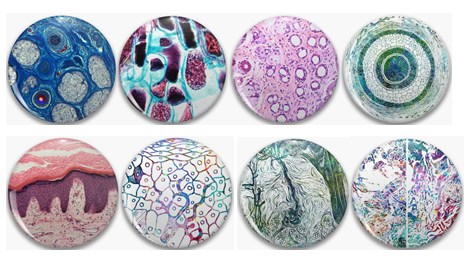
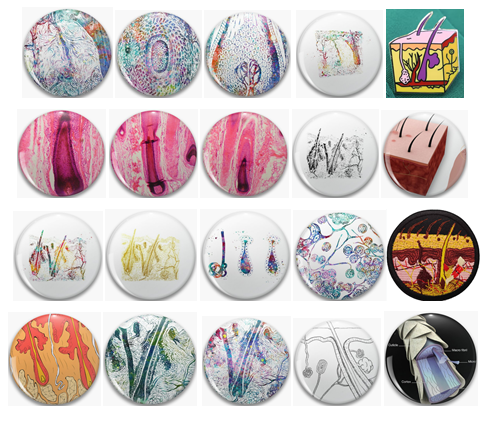
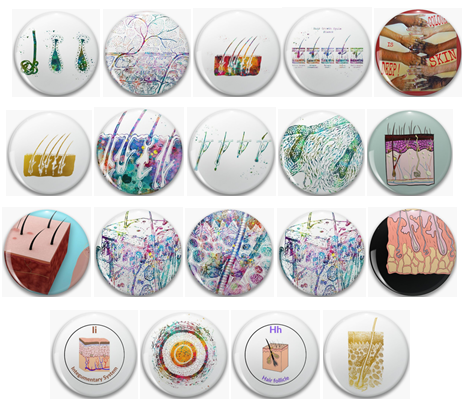
Figure 10. Thematic badges dedicated to the structure and histology of human hair.
This concludes another article devoted to the question of a number of human cells, as reflected in various collecting methods, such as philately, philocarty, phaleristics, and numismatics.
Conclusion
1. The author of this article has comprehensively, interestingly, and engagingly covered a relatively complex topic concerning the representation of the structure/anatomy and histology of certain cells in collecting methods such as philately, philocarty, phaleristics, and numismatics.
2. The author's use of screenshots of puzzle-like collection materials as illustrations significantly enriches and enhances this research article.
3. Auxiliary scientific and historical disciplines such as philately, philocarty, phaleristics, and numismatics, as well as a number of other collecting methods and tools, are quite capable of vividly, creatively, and comprehensively presenting highly interesting information for both interested readers and those seriously interested in various collecting disciplines, enriching their knowledge of the subject under study.
4. In total, in this research article, the author presents 248 screenshot copies of collectible materials, including: philatelic (postage stamps and envelopes) - 47 screenshot copies; philocarty (postcards) - 13 copies; phaleristics (thematic badges and brooches) - 180 copies; numismatics (commemorative table medals and coins) - 8 screenshot copies.
Conflict of interest
The author notes the complete absence of any conflicts, both with individuals and legal entities.
References
- Bugaevsky K.A., Bugaevskaja N.A. Neurology and neuropathologists in the mirror of philately, phaleristics, numismatics and bonistics // Bulletin of SMUS74. 2016. 3 (14):14-29.
View at Publisher | View at Google Scholar - Bugaevsky K.A., Anatomy and histology of the human skin and hair on the mirror thematic badges.
View at Publisher | View at Google Scholar - Cell Biology Badges & Pins | Zazzle UK
View at Publisher | View at Google Scholar - Explore the Different Types of Cells in Human Body - GeeksforGeeks
View at Publisher | View at Google Scholar - Types of Cell poster. Credit: Human Body - Facts at Your Fingertips. Part 2
View at Publisher | View at Google Scholar - Explore the Different Types of Cells in Human Body – GeeksforGeeks
View at Publisher | View at Google Scholar - 6. Red Blood Cell Buttons – CafePr CafePress
View at Publisher | View at Google Scholar - Red Blood Cell Buttons – CafePress
View at Publisher | View at Google Scholar - Anemia Medical Alert Bad The Badge Centre
View at Publisher | View at Google Scholar - Iron deficiency anemia
View at Publisher | View at Google Scholar - 8-15Anatomy Button Pins Badges Black White Human Anatomical Heart URL: https:// Etsy UK (accessed 25.04.2024).
View at Publisher | View at Google Scholar - Anatomy Button Pins badges black URL: https:// Art Altered (accessed 25.04.2024).
View at Publisher | View at Google Scholar - Human Anatomy Button Badges / Northern Delight URL: https:// Big Cartel (accessed 25.04.2024).
View at Publisher | View at Google Scholar - Human Body Bone Foot Sketch Round Pins Badge Button Clothing Decoration URL: https:// 5pcs Gift (Accessed 25.04.2024).
View at Publisher | View at Google Scholar - White Blood Cell Leukocyte Neutrophils Biology Anatomy Postcard
View at Publisher | View at Google Scholar - Human blood cells, illustration (F029/5858) Postcard
View at Publisher | View at Google Scholar - Human blood cells, light micrograph (P242/0455) Postcard
View at Publisher | View at Google Scholar - Colour SEM of red & white blood cells (P242/0218) Postcard
View at Publisher | View at Google Scholar - Blood clot, SEM (P260/0107) Postcard
View at Publisher | View at Google Scholar - Red Blood Cell Pattern Postcard
View at Publisher | View at Google Scholar - Blood Components Postcard
View at Publisher | View at Google Scholar - Blood cells, illustration (F029/5858)
View at Publisher | View at Google Scholar - Blood vessel with platelets, white blood cells and red blood cells. Postcard
View at Publisher | View at Google Scholar - Artery cross section with red blood cell flow. Postcard
View at Publisher | View at Google Scholar - Conceptual image of platelet, red blood cell and white blood cell.
View at Publisher | View at Google Scholar - Medicine Ramon y Cajal texture of the nervous system - Buy and sell in all collections - Santiago Ramón y Cajal.
View at Publisher | View at Google Scholar - Neuroscience on Stamps Malagasy Charles Sherrington/Otto Loewi: 1932 Nobel Prize winner / 1936 Nobel Prize winner Neurosurgery Medicine, Portuguese-Spanish Congress, OVI – “Buy and sell in the collection 2. Neurons” Pin for Sale.
View at Publisher | View at Google Scholar - Cheap Neurologist Brooch Brain N URL: https:// Joom (date of the application 01.10.2023).
View at Publisher | View at Google Scholar - Neuroscience Brain Neuron Nervous System Enamel Brooch
View at Publisher | View at Google Scholar - COV 92 - 312 National Congress of Neurology, Romania - cover - used – 1978
View at Publisher | View at Google Scholar - MEDICINE/ CENTRAL NERVOUS SYSTEM 1906 Nobel Prize CAMILLO GOLGI Bronze Medal
View at Publisher | View at Google Scholar - Medal of the V International Congress of Neurology, Lisbon 1953, Tarouca and Dalvares.
View at Publisher | View at Google Scholar - Florinus.LV2020 Cyprus Institute of Neurology and Ge
View at Publisher | View at Google Scholar - Commemorative Envelope, Medicine, Health, 1973, X International Congress of Neurology
View at Publisher | View at Google Scholar - 50073. Letter from Barcelona, 1973. Congress of Neurology. Medicine.
View at Publisher | View at Google Scholar - Neuroscience Badges & Pins | Zazzle UK
View at Publisher | View at Google Scholar - Human Reproductive Systems Kit – Realityworks
View at Publisher | View at Google Scholar - What's the Deal with Mail-In Sperm Start-Ups? - The New York Times
View at Publisher | View at Google Scholar - Pine cone, epidermal cells
View at Publisher | View at Google Scholar