 Clinic
Research Article | DOI: https://doi.org/10.31579/2835-8295/148
Cancer Mortality in Iraq: 2025 Overview and Historical Context
Advisor doctor and expert trainer Baghdad Medical City and the National Training Center. Baghdad, Iraq
*Corresponding Author: Aamir Jalal Al-Mosawi, Advisor doctor and expert trainer Baghdad Medical City and the National Training Center. Baghdad, Iraq.
Citation: Aamir Jalal Al-Mosawi, (2026), Cancer Mortality in Iraq: 2025 Overview and Historical Context, International Journal of Clinical Reports and Studies, 5(2); DOI:10.31579/2835-8295/148
Copyright: © 2026, Aamir Jalal Al-Mosawi. This is an open-access artic le distributed under the terms of the Creative Commons Attribution License, which permits unrestricted use, distribution, and reproduction in any medium, provided the original author and source are credited.
Received: 22 January 2026 | Accepted: 19 February 2026 | Published: 02 March 2026
Keywords: cancer mortality; Iraq; lung cancer; breast cancer; epidemiology; who; public healt; eastern mediterranean region
Abstract
Background: Cancer has become a leading cause of death worldwide, including in Iraq, where cancer incidence and mortality have increased steadily over recent decades. Understanding recent mortality trends is essential for national cancer control planning.
Objective: To describe the pattern of cancer mortality in Iraq based on the most recent data released by the Iraqi Ministry of Health in 2025 and to place these findings in historical and regional context. Methods: Official data on cancer mortality released in 2025, primarily based on cases recorded in 2022, were analyzed by gender and cancer site. Historical information and regional/global statistics from WHO and international cancer registries were used for comparison and interpretation.
Results: Cancer mortality in Iraq was dominated by lung cancer in males (21%) and breast cancer in females (22%). Other leading causes of cancer death among males were brain (9%), pancreas (7%), liver (6%), prostate (6%), and bladder (6%) cancers. Among females, lung (11%), brain (8%), pancreas (5%), liver (5%), and colorectal (5%) cancers were most frequent. The mortality structure aligns with global patterns but shows relatively high proportions of lung and breast cancer deaths compared with neighboring countries. The mortality profile demonstrates both continuity and evolution compared to previous decades.
Conclusion: Cancer mortality in Iraq remains a major public health concern. Targeted prevention strategies, nationwide screening programs, and equitable oncology services are crucial to reduce avoidable deaths. Iraq’s half-century cancer data provide a valuable framework for designing evidence-based cancer control policies.
Introduction
Cancer isone of the foremost public health challenges globally and is increasingly so in Iraq. The World Health Organization (WHO) estimates that lung cancer is the leading cause of cancer death worldwide (~1.8 million deaths, or ~18.7% of all cancer deaths), followed by colorectal, liver, breast, and stomach cancers. In women, breast cancer remains the most commonly diagnosed cancer and the leading cause of cancer mortality, while in men; lung cancer typically occupies that position. In the Eastern Mediterranean and Arab region, including Iraq, cancer incidence and mortality have been rising steadily. In the Arab world, breast cancer is by far the most prevalent cancer, followed by lung, colorectal, cervical, and prostate cancers. The region is projected to experience a nearly 1.8-fold increase in cancer incidence by 2030 due to demographic changes (aging and population growth), lifestyle factors (tobacco use, dietary shifts, and physical inactivity), environmental exposures, and limitations in early detection and healthcare infrastructure [1-5]. For Iraq, a steady increase in cancer incidence and mortality over the past decades has been reported. Earlier age-standardized rates were relatively low, but by 2018 the incidence rate had reached 82.6 per 100,000 population. The Iraqi cancer profile has also evolved with lung, breast, and colorectal cancers replacing bladder and skin cancers as dominant causes of death underscoring the importance of continuous monitoring and national cancer control strategies [1].
Methodology
This analysis examined official unpublished data released by the Iraqi Ministry of Health in 2025. Most of the underlying data were collected during 2022 and provide national mortality statistics by cancer site and gender.
Results
Cancer mortality in Iraq during was dominated by lung cancer in males and breast cancer in females. The top ten causes of cancer deaths in males were: lung (21%), brain (9%), pancreas (7%), liver (6%), prostate (6%), bladder (6%), colon (5%), stomach (5%), leukemia (4%), and larynx (2%). In females, the leading sites were: breast (22%), lung (11%), brain (8%), pancreas (5%), liver (5%), colon (5%), stomach (5%), ovary (3%), leukemia (3%), and bladder (2%). Lung cancer alone accounted for over one-fifth of male cancer deaths, while breast cancer represented more than one-fifth of female cancer deaths. These findings are consistent with global and regional trends, although Iraq demonstrates a relatively higher burden of lung and breast cancer compared to some neighboring countries
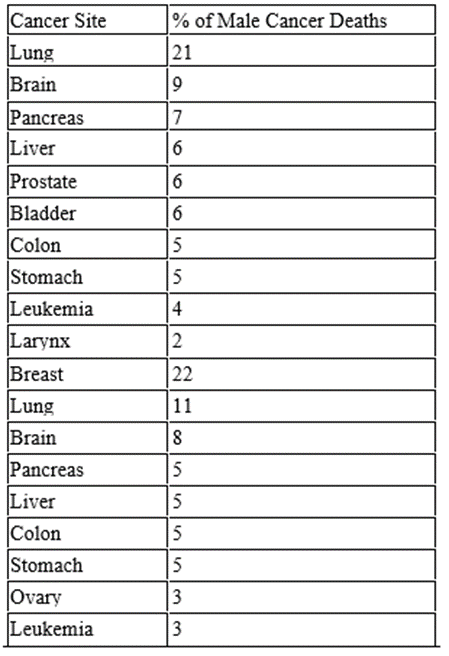
Table-1A: Cancer Mortality (Males)
Discussion
The current cancer mortality profile in Iraq shows both continuity and change when compared with data from previous decades. Historically, bladder and skin cancers were among the most frequent malignancies in the 1970s and 1980s, but the modern era has witnessed a rise in lung, breast, and colorectal cancers. The incidence of malignant diseases increased from 38.9 per 100,000 in 1994 to over 82 per 100,000 by 2018. This rise reflects a combination of factors including an aging population, urbanization, environmental exposures, and lifestyle changes such as smoking and diet. A steady rise in the incidence of malignant diseases, from 38.9 per 100,000 population in 1994 to over 82 per 100,000 by 2018 [1]. This rise can be attributed to multiple factors, including aging population, environmental exposure, and lifestyle changes such as smoking and diet. Despite significant advances in cancer diagnosis and treatment, the mortality data reveal that many patients in Iraq still present at advanced stages, emphasizing the importance of public health strategies focused on prevention, early detection, and accessible oncology services across all provinces. When compared to other countries in the Eastern Mediterranean Region (EMR), Iraq’s cancer mortality structure shows similarities but also distinctive features. For instance, Saudi Arabia and Jordan report rising incidence of breast, colorectal, and thyroid cancers, while Egypt and Lebanon face increasing rates of liver and lung cancers.
Iraq, however, exhibits a relatively high proportion of lug
References
- Al-Mosawi AJ. (2022). Cancers in Iraq: Half century overview. The American Journal of Medical Sciences and Pharmaceutical Research.; 4(7):5–38.
View at Publisher | View at Google Scholar - World Health (2024). Organization. Global cancer burden growing amidst mounting need for services. WHO News, Feb.
View at Publisher | View at Google Scholar - Arafa MA, Rabah DM, Farhat KH. (2020). Rising cancer rates in the Arab World: now is the time for action. East Mediterr Health J Jun 24; 26(6):638-640.
View at Publisher | View at Google Scholar - GBD (2015) Eastern Mediterranean Region Cancer Collaborators. Burden of cancer in the Eastern Mediterranean Region, 2005-2015: findings from the Global Burden of Disease 2015 Study. Int J Public Health. May; 63(Suppl 1):151-164.
View at Publisher | View at Google Scholar - Althubiti MA, (2018). Nour Eldein MM. Trends in the incidence and mortality of cancer in Saudi Arabia. Saudi Med J. Dec; 39(12):1259-1262.
View at Publisher | View at Google Scholar