 Clinic
Research Article | DOI: https://doi.org/10.31579/ 2834-5134 /077
Role Of Four Post Collar in Management of Post Burn Contracture of Neck
- Padmalakshmi Bharati Mohan 1
- Nabiel Salam 2
- Ravi Kumar Chittoria 3*
- Shanmuga Priya R 4
- Kanav Gupta 4
1 Assistant professor, Department of Plastic Surgery JIPMER, Puducherry, India.
2 Junior Resident, Department of Orthopaedic Surgery JIPMER, Puducherry, India.
3 Professor & Registrar (Academic), Head of IT Wing and Telemedicine, Department of Plastic Surgery & Telemedicine JIPMER, Pondicherry, India.
4 Senior Resident, Department of Plastic Surgery JIPMER, Puducherry, India.
*Corresponding Author: Ravi Kumar Chittoria, Professor & Registrar (Academic), Head of IT Wing and Telemedicine, Department of Plastic Surgery & Telemedicine JIPMER, Pondicherry, India.
Citation: Kanav Gupta, Ravi Kumar Chittoria (2025), Role of Four post Collar in Management of Post Burn Contracture of neck, Journal of Clinical Anatomy; 4(6); DOI: 10.31579/ 2834-5134 /077.
Copyright: © 2025, Ravi Kumar Chittoria. This is an open access article distributed under the Creative Commons Attribution License, which permits unrestricted use, distribution, and reproduction in any medium, provided the original work is properly cited.
Received: 01 November 2025 | Accepted: 15 November 2025 | Published: 28 November 2025
Keywords: burns; contracture; neck
Abstract
Post-burn contracture is a serious problem associated with the disability of the patient causing restriction of daily activities. Post-burn contracture involving the neck, face, upper extremity and lower extremity causes severe disability of the patient. Post burns patients should be given adequate splinting of joints to prevent contractures. For splinting of joints and for preventing contractures we have materials in the market. In this article, we are going to assess the usage of Distractible four post collar in the prevention of contracture.
Introduction
Morbidity from hypertrophic scars and contractures, which are well-known burns complications, is still significant and has even risen as more badly burnt patients survive. The purpose of management is to restore the original function and form. Post-burn neck contractures can influence not only the movements of the neck but also the function of the lower face, as well as cause tracheal change and cervical spine distortion. Because these contractures cause significant functional and cosmetic issues, as well as economic and psychosocial consequences, operative correction is usually recommended, especially in children, where they can cause growth imbalance in the head and neck area. Release of the scar, restoration of cervical motions, look, and natural profile, and prevention of contracture recurrence are the goals of surgical intervention. The goal of this study was to see how effective distractible four post collars are at preventing burn contracture.
Materials And Methodology
In this case, report we used Four post collar for an 11-year-old young lady with post burns contracture involving her face and neck. We used four-post collar in this patient 3 months after the burns. The contracture band started to occur in the neck post burns. Before using it, three neck measurements were taken from the angle of the mandible to the clavicle on both sides (A and B) and from the chin to the sternal notch (C). The measurements are A- 8 cm, B- 9 cm, C- 11 cm.
Every day, the patient wore it from 7 am to 5 pm continuously followed by maintenance with a soft cervical collar. The contracture was stable during the period of usage of distractable four post collar after 1 year of burns. The measurements post usage were A– 11 cm, B- 12 cm, C- 15 cm. During the period of usage of the collar, the contracture did not progress in severity and the contracture was stable during the period of usage.
Four post collar is made of malleable aluminium anterior and posterior support with proper ethafoam padding. Front and back have two adjustable rods with anterior chin supports & posterior occipital support which ensures perfect cervical immobilization. There are two shoulders and two auxiliaries adjustable –Hook loop decline straps which enhance proper fitting. Adjustable all four rods allow surgeons to give proper distraction to the cervical spine
Results
In our study, four post collar was successful in preventing and progression of severe post burns contracture of the neck. The measurements taken from the patient show that neck contracture was stable and the scar released up to 4 cm after the usage for the past 1 year. The patient experience and feedback were favourable as it was easy to use and easy to apply. There were no reported complications like scar breakage, or non-compliance observed with the use of four post collar.
Discussion
During acute burn treatment, patients assume a comfortable position; affected joints or regions must be splinted in functional positions to avoid contractures. Particularly with the rising trend towards ambulatory burn care, continuous monitoring by the burns team and patient education is necessary to obtain the optimum functional result. Contractures can arise even with proper initial treatment, necessitating a change in splinting strategies to repair the deformity1. If more restoration is required, the afflicted area is restored to its original function. Pressure therapy to prevent and treat hypertrophic burn scars is an important part of burn care, despite the fact that the physiologic mechanism is yet unknown. Treatment options include a variety of materials and methods that can be used immediately after the burn wound has healed and changed as needed until the scar has matured. Neck abnormalities continue to be a substantial cause of morbidity in children who have been burned. Reconstructive efforts must focus on not only restoring proper head position, flexion/extension, and rotation but also on meeting the patient's cosmetic and functional goals2, 3. Splintage should consist of a static splint for 4–6 weeks, and then a dynamic splint until the graft is soft, supple, and wrinkle-free. Contractures should ideally be avoided by nursing the patient with a neck extension during the acute phase of wound healing and wearing a cervical collar during the sub-acute period4. The preoperative use of splints may lead to lesser surgical intervention and in selective cases obviate surgery. Thermal burns which are the most common cause of contractures of the upper limb show the maximum response to preoperative serial splint. Patients with minor contracture and supple tissues are fully corrected with splints without surgical intervention. In patients undergoing surgical correction, skin graft decreases due to decreased contracture angle by using dynamic splints to prevent contractures5. By organizing the degree of contracture with the scar type, a simple classification system for PBC Linear scar, Band scar, and Broad scar can cause mild, moderate or severe contractures. Post-burn mentosternal contractures can be clinically classified into 4 major groups based on the location of the contracting bands and the extent of flexion or extension away from the anatomical position of the neck and jaws7.
Severe post-burn neck contracture results in difficult intubation, which can be life-threatening and can result in multiple serious complications and sequels. The patients can be operated under local tumescent anaesthesia supplemented
with intravenous ketamine for release of post-burn neck contracture and split skin grafted. This technique obviates the need for endotracheal intubation. There were no complications attributed to this anaesthesia technique. There was no graft loss and blood loss were minimal8.
Conclusion
In our study we have observed that distractible four post collar has a role in the prevention of post burn scars with good patient compliance and without any complications. However, since it is a study involving a single patient, a definitive conclusion cannot be made. Large randomized control trials are required to confirm the efficacy of this method. Four post collar will be useful in preventing neck contracture.
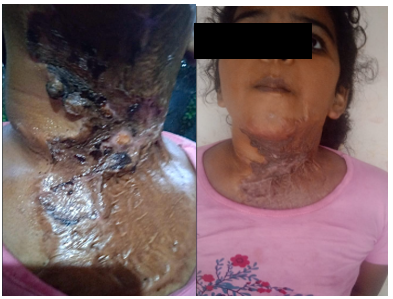
Figure 1: Patient with post burns contracture neck
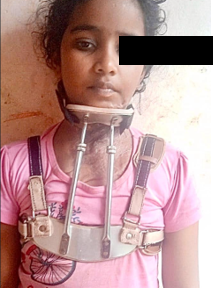
Figure 2: Patient with four post collars.
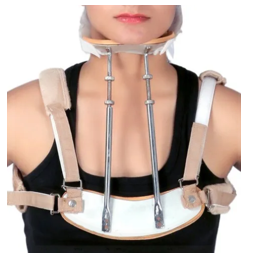
Figure 3: Four post collar
Conflicts of interest
None
Authors’ contributions
All authors made contributions to the article
Availability of data and materials
Not applicable.
Financial support and sponsorship
None.
Consent for publication
Not applicable
References
- Jordan R B, Daher J, Wasil K; Splints and scar management for acute and reconstructive burn care. Clin Plast Surg 2000 Jan; 27(1):71-85.
View at Publisher | View at Google Scholar - Burn scar contractures of the pediatric neck; J Craniofac Surg. 2008 Jul; 19(4):1010-5.
View at Publisher | View at Google Scholar - Mohmmed Saygin Abdul Kadir. Post burn flexion neck contracture. Tikrit medical journal. 2007; 13(1):116–21.
View at Publisher | View at Google Scholar - Bhattacharya S, Bhatnagar S K, Chandra R. Post burn contracture of the neck – our experience with a new dynamic extension splint. Burns. 1991; 17:65.
View at Publisher | View at Google Scholar - Vinita puri et al Serial splintage: Preoperative treatment of upper limb contracture, 2013 Sep; 39(6):1096-100. doi: 10.1016/j.burns.2013.01.010. Epub 2013 Feb 28.
View at Publisher | View at Google Scholar - Makboul Mohamed, El-Otteify Mahmoud. Classification of post burn contracture neck. Indian journal of burns. 2013; 21(1):50–54.
View at Publisher | View at Google Scholar - Igwilo Onah Ifeanyichukwu. A classification system for post burn mentosternal contracture. Arch Surg. 2005; 140:671–75.
View at Publisher | View at Google Scholar - Agrawal Pawan, et al. Safe method for release of severe post-burn neck contracture under tumescent local anaesthesia and ketamine. Indian journal of plastic surgery. 2004; 37(1):51–54.
View at Publisher | View at Google Scholar