 Clinic
Case Report | DOI: https://doi.org/DOI:10.31579/2835-7957/153
Progress of a Critical Patient with Granulomatosis with Polyangiitis (GPA) following Dental Treatment
- Zilma Ribeiro do Nascimento
- Michelle Maria Gonçalves de Godoy
- Leonardo Cavalcanti Bezerra dos Santos
- Kátia Maria Gonçalves Marques
- Niedje Siqueira de Lima
- Luciana de Barros Correia Fontes
Federal University of Pernambuco (Clinic Hospital – HC-UFPE/Ebserh)
*Corresponding Author: Luciana de Barros Correia Fontes, Federal University of Pernambuco (Clinic Hospital – HC-UFPE/Ebserh).
Citation: Zilma Ribeiro do Nascimento, Michelle Maria Gonçalves de Godoy, Leonardo Cavalcanti Bezerra dos Santos, Gonçalves Marques KM, Niedje Siqueira de Lima, et al, (2026), Progress of a Critical Patient with Granulomatosis with Polyangiitis (GPA) following Dental Treatment, Clinical Reviews and Case Reports, 5(1); DOI:10.31579/2835-7957/153
Copyright: © 2026, Luciana de Barros Correia Fontes. This is an open-access article distributed under the terms of the Creative Commons Attribution License, which permits unrestricted use, distribution, and reproduction in any medium, provided the original author and source are credited.
Received: 02 February 2026 | Accepted: 16 February 2026 | Published: 23 February 2026
Keywords: granulomatosis with polyangiitis; respiratory insufficiency; oral health; intensive care units
Abstract
Objective: to report the case of an adult woman admitted to the ICU of a referral university hospital with shortness of breath, otitis, sinusitis and severe pain in the oral region, without a definite diagnosis.
Case report: A 35-year-old woman was admitted to the clinical ICU of the Hospital das Clínicas in the city of Recife, northeastern Brazil, in January 2025. At the time, she presented with severe respiratory failure and intense pain in the oral region. The diagnostic hypothesis of granulomatosis with polyangiitis (GPA) was confirmed, with a request for dental evaluation by the multidisciplinary team.
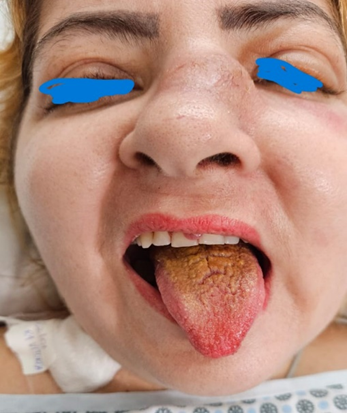
Results: The intraoral examination showed the presence of oedema, hyperaemia and tongue coating. The dental surgeon performed prophylaxis, tongue cleaning, supragingival scaling, and mouth rinsing. After the treatment, the pain was reduced, and the patient was referred to the infirmary and discharged after 48 hours of hospitalisation in the ICU.
Conclusion: Although considered a rare condition, early diagnosis and intervention by dentistry, in conjunction with the physician and the multidisciplinary health team, contributed to a favourable outcome and had a positive impact on the quality of life of the patient in question.
Introduction
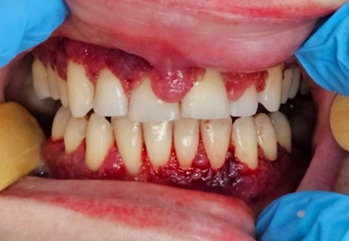
Granulomatosis with polyangiitis (GPA), formerly known as Wegener's Granulomatosis (WG), is rare but debilitating autoimmune disease. It is a potentially fatal autoimmune vasculitis that affects small blood vessels. Although it has a variable clinical presentation, there is a predominance of upper respiratory tract involvement, including sinonasal, otological, or tracheal symptoms. GPA can lead to severe morbidity and life-threatening organ involvement; therefore, early recognition and treatment are crucial [1] [2]. The first manifestation of the disease can be seen in the oral cavity. It is important that dentists recognise the oral manifestation in order to improve the prognosis. Hyperplastic granular gingivitis or "strawberry gingivitis" is a rare manifestation of GPA/WG but it is nearly pathognomonic for this multisystem autoimmune vasculitis. The dentist may be the first health care professional to see patients with symptoms and findings of this condition. Early diagnosis and treatment is the most important factor in the management of this potentially fatal disease [3] [4]. Despite the importance of intraoral examination for the diagnosis and early treatment of this life-threatening condition, there are gaps in the literature regarding the benefits of dental care; the main objective of this study.
Case report
A 35-year-old woman with leukoderma and grade 1 obesity (Body Mass Index 31) was admitted to the Hospital das Clínicas of the Federal University of Pernambuco (UFPE) with episodes of otitis, sinusitis, and severe pain in the oral region. In addition to a suspected diagnosis of GPA/Wegener's granulomatosis. The patient was taken to the operating room for a biopsy of the lesion in the nasal mucosa. During surgery, the patient presented severe hypotension; with the option of not extubating her and referring her to the ICU. With recurrent sinusitis and otitis and the presence of pulmonary granules, the rheumatology team investigated GPA. Within 24 hours of her admission, with saturation parameters of 95, respiratory rate of 12 breaths per minute, heart rate of 99 beats per minute, and blood pressure of 107/78, she was immediately extubated. There was also a record of hypernasal voice and mouth breathing, throat clearing, with signs of nasal penetration and leakage. The dental surgeon was called by the multidisciplinary team to assess the patient in question. On intraoral examination, she found: significant tongue coating, oedema, gingival hyperaemia and severe toothache. After dental care with prophylaxis, using hydrogen peroxide, saline solution (1:1 ratio, mouthwash with distilled water and mouthwash with 8.3% sodium bicarbonate), the patient reported improvement in oral pain symptoms. Following the oral environment adjustment procedure, supragingival scaling was performed, the tongue was cleaned with hydrogen peroxide and sodium bicarbonate, and the intervention was completed with a 0.12% chlorhexidine mouthwash. Immediately after periodontal treatment, the patient presented a reduction in pain and was discharged to the ward.
Below are images of the patient in this case report.
Conclusion
The multidisciplinary healthcare team should be familiar with the wide variety of oral and systemic components of GPA, as well as strategies to facilitate immediate recognition of the disease and provide ongoing oral healthcare to these patients with complex medical conditions.
References
- Webb, H., Toppi, J., Fairley, J. And Phillips, D. (2024). Granulomatosis with Polyangiitis: a rare but clinically important disease for the otolaryngologist. Niger J Clin Pract, 27, 819-826.
View at Publisher | View at Google Scholar - Sasmithae, L. (2023). The Challenges of diagnosis and management of Wegener's Granulomatosis with negative ANCA. Acta Med Indones, 55, 194-200.
View at Publisher | View at Google Scholar - Stewart, C., Cohen, D., Bhattacharyya, I., Scheitler, L., Riley, S., et al. (2007). Oral manifestations of Wegener's granulomatosis: a report of three cases and a literature review. J Am Dent Assoc., 138, 338-348.
View at Publisher | View at Google Scholar - Apoita-Sanz,M., Blanco-Jauset, P., Polis-Yanes, C., Penin-Mosquera, R.M., Montserrat-Gomá, G., et al. (2020). Granulomatosis with Poliangeitis (Wegener's Granulomatosis): orofacial manifestations. systematic review and case report. Oral Health Prev Dent.,18, 929-943.
View at Publisher | View at Google Scholar