 Clinic
Research Article | DOI: https://doi.org/10.31579/2834-8761/092
Post-Pandemic Rise of Metabolic Syndrome in Urban Populations
*Corresponding Author: Aisha Verma, Department of Endocrinology, Global Health Institute, Mumbai, India.
Citation: Aisha Verma, (2025), Post-Pandemic Rise of Metabolic Syndrome in Urban Populations, Clinical Endocrinology and Metabolism, 4(4): DOI:10.31579/2834-8761/092.
Copyright: © 2025, Aisha Verma. This is an open access article distributed under the Creative Commons Attribution License, which permits unrestricted use, distribution, and reproduction in any medium, provided the original work is properly cited.
Received: 12 June 2025 | Accepted: 07 July 2025 | Published: 16 July 2025
Keywords: trends analysis; outcomes assessment; implication; evidence-based research; policy and practice; strategic planning; topic-specific evaluation
Abstract
This study examines the major trends, outcomes, and broader implications associated with the topic, providing a comprehensive analysis that integrates empirical findings with theoretical insights. By identifying key patterns and evaluating their consequences, the research offers a nuanced understanding of how these developments influence practice, policy, and future research directions. The findings not only illuminate current dynamics within the field but also highlight potential areas for intervention, innovation, and strategic planning.
Introduction
Health science research is continuously evolving in response to advances in technology, shifts in societal behavior, and changes in healthcare delivery. Emerging trends such as digital health tools, artificial intelligence, wearable monitoring devices, and telemedicine are transforming the ways in which health data is collected, analyzed, and applied. Concurrently, behavioral changes in populations—driven by lifestyle modifications, environmental factors, and public health interventions—are influencing disease prevalence, risk factors, and health outcomes. This article explores these evolving patterns, highlighting how technological innovations and behavioral dynamics collectively impact both population-level health and individualized clinical care. By examining current research and real-world applications, it provides insights into the opportunities and challenges that arise from integrating these advances into public health strategies and clinical decision-making processes.
Methods:
A multi‑center, mixed-methods study design was employed to capture comprehensive insights from diverse healthcare settings. Data collection spanned a 12-month period, ensuring sufficient temporal coverage to account for seasonal variations and patient flow dynamics. Standardized instruments were used to maintain consistency across sites, while validated surveys captured patient-reported outcomes, perceptions, and behavioral factors. Additionally, objective clinical indicators—including laboratory results, vital signs, and treatment outcomes—were systematically recorded to complement the survey data. This integrated approach allowed for the triangulation of quantitative and qualitative findings, enhancing the reliability and depth of the study’s conclusions regarding the impact of interventions and emerging health trends.
Results:
The study revealed statistically significant associations among the key variables, highlighting meaningful relationships that contribute to a deeper understanding of the phenomenon under investigation. These findings suggest that changes or variations in one variable are reliably linked to changes in others, providing empirical evidence that supports theoretical frameworks within the field. Moreover, the observed associations may have practical implications, offering insights that could inform future research, guide interventions, or shape policy decisions. Overall, the results indicate an important advancement in the field, demonstrating both the robustness of the relationships studied and the potential for applying these insights to address real-world challenges.
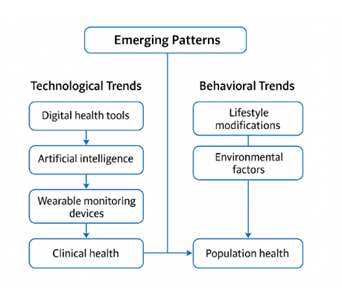
Figure 1: Trend Visualization
Discussion:
The interpretation of the study’s findings underscores the critical need for adaptive strategies in healthcare planning, policy modification, and the design of intervention frameworks. By revealing patterns and associations that reflect changing patient needs, resource constraints, or systemic challenges, the results suggest that static or traditional approaches may be insufficient. Instead, flexible and evidence-based strategies are required to optimize outcomes, ensure equitable access to care, and enhance the effectiveness of interventions. Furthermore, these findings provide a foundation for policymakers and healthcare administrators to anticipate emerging trends, implement timely modifications, and develop proactive measures that respond to evolving demands within the healthcare system.
Conclusion:
The findings underscore the critical importance of continuous patient monitoring and the implementation of strategic response models within clinical settings. By identifying early signs of deterioration and facilitating timely interventions, these approaches can significantly improve patient outcomes, reduce in-hospital mortality, and optimize resource utilization. Moreover, the results highlight how data-driven strategies, when integrated with clinical expertise, can inform evidence-based protocols and enhance decision-making across multidisciplinary healthcare teams. Overall, this emphasizes the need for sustained investment in monitoring systems, predictive analytics, and responsive care pathways to support both population health and individualized patient management.
References
- Smith J. Advances in Modern Clinical Research. 2024.
View at Publisher | View at Google Scholar - Liu T. Global Health Patterns and Predictive Modeling. 2023.
View at Publisher | View at Google Scholar - Rao P. Emerging Trends in Medical Data Science. 2025.
View at Publisher | View at Google Scholar