 Clinic
Research Article | DOI: https://doi.org/10.31579/ 2834-5134 /075
Innovative Redesign of the Conventional Skin Board for Enhanced Split-Thickness Skin Grafting Efficiency
1 Senior Resident, Department of Plastic Surgery JIPMER, Puducherry, India.
2 Senior Professor and Associate Dean (Academic), Head of IT Wing and Telemedicine, Department of Plastic Surgery and Telemedicine JIPMER, Puducherry, India.
*Corresponding Author: Ravi Kumar Chittoria, Senior Professor and Associate Dean (Academic), Head of IT Wing and Telemedicine, Department of Plastic Surgery and Telemedicine JIPMER, Puducherry, India.
Citation: Kanav Gupta, Ravi Kumar Chittoria (2025), Innovative Redesign of the Conventional Skin Board for Enhanced Split-Thickness Skin Grafting Efficiency, Journal of Clinical Anatomy; 4(5); DOI: 10.31579/ 2834-5134 /075.
Copyright: © 2025, Ravi Kumar Chittoria. This is an open access article distributed under the Creative Commons Attribution License, which permits unrestricted use, distribution, and reproduction in any medium, provided the original work is properly cited.
Received: 02 September 2025 | Accepted: 15 September 2025 | Published: 30 September 2025
Keywords: skin grafting; skin board; split skin graft; modified skin board; liquid paraffin
Abstract
Skin boards are a pair of wooden boards used during skin harvesting to flatten the surface and ease the passage of the oncoming skin knife. The skin board is used to tense the skin by pressing the board against the skin and then pulling the two boards apart therefore creating a tension on the skin and flattening the surface. For the easy passage of the knife a lubricant is used on the skin (example- Vaseline, liquid paraffin). The conventional skin boards scrape away most of this lubricant while stretching the skin. A modification has been made to the conventional skin boards by adding small channels on the surface of the board which lets lubricant slide through it and thus the lubricant remains on the skin to be harvested. This modification does not reduce the capacity of the skin board to tense the skin and provides a flat well lubricated surface for the skin knife to pass.
Introduction
Skin graft is the cornerstone of plastic surgery. It was first performed by Reverdin and later modified by Brown et al who described in detail full thickness, intermediate thickness and epidermal (Thiersch) grafts and pointed out the advantages and disadvantages of each. The basic principles of skin grafting remain the same till date.
Skin grafts are used in a variety of clinical situations such as traumatic wounds, defects after oncological resections, burn reconstruction, scar contracture release, congenital skin deficiencies, hair restoration, vitiligo, and nipple areola reconstruction. Being such a versatile procedure, it is impervious that the technique for performing the skin graft should be refined till it reaches perfection. One such advancement is going to be discussed in the current article.
Conventional skin grafting uses two wooden boards to flatten the skin to ease the usage of the skin knife by proving a flat and smooth surface. However, the usage of skin board leads to lubricant being scrapped away from the surface of the skin. A modification has been made to the conventional skin board to include a number of small channels to the angled edge which comes in contact with the skin, so as to allow small streams of lubricant to pass through the channels and assist the oncoming skin knife.
Materials And Methods
A modification was made to the conventional skin board by including a number of small channels to the angled edge which comes in contact with the skin. The channels are spaced 1 cm apart and are 1mm in depth. The result is to pass a small stream of lubricant through the channels and assist the easy passage of oncoming knife.
The skin board is usually made up of medical grade teak wood. The conventional skin board was taken to a woodworker and the channels were drilled in the board. Naturally only the board that is preceding the knife needs to have the channels. The board was subjected to the autoclaving and was ready for use in the operation theatre.

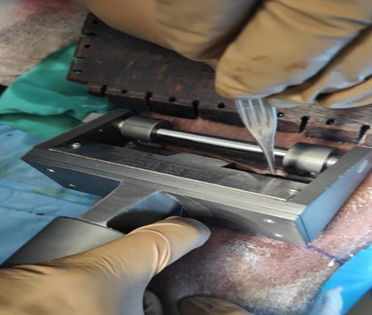
Fig1: The modified skin board with channels for the lubricant being shown in use
The patient was a 37-year-old male with no known comorbidities from whom autograft was taken for application over the bilateral gluteal region following deep thermal burn injury. The patient was posted for excision and split skin grafting using dermatome and the modified skin board was used for the same. It was noted that the ability of the board to tense the skin was in no way reduced. The lubrication was retained on the skin even after passing the skin board due to the channels.
Discussion
Skin graft is one of the most indispensable techniques in plastic surgery. It is used in a variety of clinical situations, such as, traumatic wounds, defects after oncological resection, burn reconstruction, scar contracture, release, congenital skin deficiency, hair restoration, vitiligo and nipple areolar reconstruction1,2.
Split-thickness skin grafts can be harvested by a free-hand dermatome3,4. A free-hand dermatome offers a quick method of harvesting a skin graft that does not depend on electricity or pneumatic power; thus, it is useful in harvesting small and thin grafts4,5. Infiltration of the subcutaneous tissue with tumescent prior to using a motorized dermatome can facilitate skin graft harvest, especially when harvesting skin over a bony prominence. Also, lubrication with a small amount of lubricant, example- Vaseline ointment, makes it easier to harvest the skin by decreasing the friction between the skin and the dermatome6-8.
Skin boards are used to maintain tension and get a smooth flat surface for the skin knife to harvest a skin graft. However, in the usage of the skin board to create tension the boards are run over the donor site, removing the lubricant in the process9. The current modification helps in preserving the lubricant on the skin surface due to the presence of small channels on the board. The ability of the boards to create tension is in no way reduced. The skin knife was noted to pass easily due to the lubrication10,11. The number of times the lubricant needed to be reapplied was also reduced.
Conclusion
The current modification helps in preserving the lubricant on the skin surface and helps in easier passage of the electrical dermatome. We used this skin board in one patient and have found that it greatly improves the performance of the skin graft knife or electrical dermatome.
References
- Reverdin JL. Greffes epidermiques. Bulletin de la Societe Imperiale de Chirurgie de Paris. 1869; 10:51.
View at Publisher | View at Google Scholar - Lawson G. On the transplantation of portions of skin for the closure of large granulating surfaces. Transactions of the Clinical Society of London. 1871;4: p. 49.
View at Publisher | View at Google Scholar - Ollier L. Greffes cutanee ou auto plastiques. Le bulletin—Académie Nationale de Médecine de Paris. 1872;1: p. 243.
View at Publisher | View at Google Scholar - Thiersh C. Uber die feineren anatomischen veranderungen bei aufheilung von Haut auf granulationen. Verhandlungen der Deutschen Gesellschaft für Chirurgie. 1874;3: p. 69.
View at Publisher | View at Google Scholar - Blair VP, Brown JB. The use and uses of large split skin grafts of intermediate thickness. Surgery Gynecology & Obstetrics. 1929;49: p. 82.
View at Publisher | View at Google Scholar - Brown JB, McDowell F. Skin Grafting. 2nd edition. Philadelphia, Pa, USA: JB Lippincott; 1949.
View at Publisher | View at Google Scholar - Valencia IC, Falabella AF, Eaglstein WH. Skin grafting. Dermatologic Clinics. 2000;18(3):521–532.
View at Publisher | View at Google Scholar - Ratner D. Skin grafting: from here to there. Dermatologic Clinics. 1998;16(1):75–90.
View at Publisher | View at Google Scholar - Mutallik S, Ginzburg A. Surgical management of stable vitiligo: a review with personal experience. Dermatologic Surgery. 2000;26(3):248–254.
View at Publisher | View at Google Scholar - Lee SS, Tsai CC, Lai CS, Lin SD. An easy method for preparation of postage stamp autografts. Burns. 2000;26(8):741–749.
View at Publisher | View at Google Scholar - Harashina T, Iso R. The treatment of leukoderma after burns by a combination of dermabrasion and “chip” skin grafting. British Journal of Plastic Surgery. 1985;38(3):301–305.
View at Publisher | View at Google Scholar