 Clinic
Research Article | DOI: https://doi.org/10.31579/ 2834-5134 /078
Analysis of Neural Networks of Mobility Habitus from 2020 to 2024
1Universidad de Los Lagos, Osorno, Chile.
2Universidad de la Salud, México.
3Universidad Autónoma del Estado de Morelos, México.
*Corresponding Author: Julio E Crespo, Universidad de la Salud, México.
Citation: Julio E Crespo, Cruz García Lirios, Francisco Rubén Sandoval Vázquez (2025), Analysis of Neural Networks of Mobility Habitus from 2020 to 2024, Journal of Clinical Anatomy; 4(6); DOI: 10.31579/ 2834-5134 /078.
Copyright: © 2025, Julio E Crespo. This is an open access article distributed under the Creative Commons Attribution License, which permits unrestricted use, distribution, and reproduction in any medium, provided the original work is properly cited.
Received: 01 December 2025 | Accepted: 15 December 2025 | Published: 29 December 2025
Keywords: neural network analysis; appropriation of space, mobility habitus; social justice; violence
Abstract
The mobility habitus has been identified as an expression of social violence, since it often emerges in contingencies. The objective of this work was to compare the theoretical structure of the mobility habitus with observations in a sample of students from central Mexico. A cross-sectional, explanatory and correlational study was carried out with a sample of 600 university students selected for their confinement and social distancing during the period from 2020 to 2024. The results demonstrate a neural sequence of learning of the mobility habitus that began with the retail sale of addictive substances and culminated in the workplace. This sequence reveals a subsystem of violence that the literature identifies as inherent to synergistic organizations. It is recommended to extend the study to the context of public mobility policies to trace the origin of violence in the State by not only permissing the retail sale of substances, but also by promoting mobility and consumption routes that allow the structuring of organizations and their supply chains.
Introduction
In the contemporary debate surrounding sustainable urban development, the concept of mobility habitus emerges as a crucial element for understanding how social, economic, and environmental dynamics intersect (Bourdieu, 1977). This study posits that the development of sustainable transport systems, particularly those with low CO2 emissions, requires a nuanced approach to analyzing the relationship between spatiality, habitus, and capacity (Bourdieu, 1990). These theoretical frameworks provide essential insights into the power dynamics and inequities embedded within urban spatial arrangements and public transportation systems.
The promotion of zero-emission public transport systems in urban centers can only succeed if policy frameworks address the socio-economic disparities that shape mobility habitus. Sustainable urban mobility is contingent upon a governance model that balances freedoms, capacities, and responsibilities while incorporating marginalized voices in the decision-making process (Sheller & Urry, 2006).
The Role of Spatiality in Urban Power Dynamics
The Theory of Spatiality highlights how cities serve as symbolic and material centers of power, where economic asymmetries between social classes are both reflected and perpetuated. Lefèbvre’s (1974) notion of urban spaces as arenas of production underscores the need to reconceptualize spatial relationships. The centrality of urban spaces often marginalizes peripheral communities, leading to unequal access to resources, including public transportation.
Spatiality’s fetishization conceals these inequalities by transforming social relations into tangible objects, making power dynamics less visible (Cresswell, 2010). Thus, equitable urban planning must prioritize the redistribution of spatial resources to foster inclusivity and mitigate the effects of spatial segregation.
Habitus and Its Influence on Mobility Patterns
Bourdieu’s (2002) concept of habitus emphasizes the role of inherited and learned dispositions in shaping mobility behaviors. In contexts of resource scarcity, such as water or transport, individuals develop austerity-driven lifestyles that reinforce systemic inequalities. Public policies often fail to account for these emergent lifestyles, which reflect deeper socio-economic vulnerabilities.
In the realm of urban mobility, habitus manifests in the reliance on informal or precarious modes of transport among marginalized populations (Kaufmann, Bergman & Joye, 2004). Addressing these inequities requires policies that align public transportation systems with the lived experiences and cultural practices of diverse urban populations.
Capacities as Determinants of Sustainable Development
Amartya Sen’s (2011) Theory of Capacities provides a framework for understanding how individual freedoms and societal responsibilities intersect to shape development outcomes. In urban mobility, capacities encompass skills, knowledge, and access to resources necessary for utilizing sustainable transport systems. When these capacities are undermined by resource scarcity or inequitable governance, the potential for sustainable urban development diminishes.
Governance systems must therefore prioritize capacity-building initiatives, such as public education on sustainable transport and investments in infrastructure that enhance accessibility (Hanson, 2010). This approach ensures that mobility systems contribute to broader goals of human and ecological sustainability.
Critics might argue that the economic feasibility of zero-emission transport systems poses a significant challenge, particularly in developing urban centers (Schwanen & Wang, 2014). However, the long-term benefits of reduced environmental degradation, improved public health, and increased economic productivity outweigh the initial costs (Adey, 2010). Additionally, international cooperation and technological innovation can help offset these costs, making sustainable mobility a viable option even in resource-constrained settings.
Another counterargument concerns the potential resistance from established economic and political elites who benefit from maintaining the status quo (Jensen, 2009). Overcoming such resistance requires robust public advocacy and participatory governance models that empower marginalized communities to voice their concerns and influence policy decisions.
The intersection of spatiality, habitus, and capacities provides a comprehensive framework for understanding and addressing the complexities of sustainable urban mobility (Urry, 2007). By recognizing the socio-economic and cultural factors that shape mobility patterns, policymakers can design transport systems that promote equity, sustainability, and resilience. Achieving these goals necessitates a shift from top-down governance to a more inclusive and participatory approach, ensuring that the voices of all urban stakeholders are heard and respected. This transition will pave the way for a truly sustainable and just urban future (see Table 1).
Authors & Year | Conceptual & Operational Definitions | Sample & Instruments | Psychometric Properties | Scope | Limitations |
Garzón et al. (2021) | Habitus defined as learned dispositions influencing mobility behavior. Operationalized through patterns of public transport use and sustainability attitudes. | 100 university students. Instrument: Mobility Habitus Scale (EHM-28). | Reliability: Cronbach's Alpha = 0.780. Validity: KMO = 0.782, Chi-square = 234.1, p < 0> | Explored the influence of income on mobility habitus; established four key dimensions. | Non-probabilistic sample; limited to a single university context. |
Sandoval, Molina & García (2021) | Habitus conceptualized as biosecurity-driven mobility practices. Operationalized via adherence to biosecurity measures in public transport. | 150 public transport users. Instrument: Sustainable Mobility Perception Questionnaire (CPMS). | Reliability: Cronbach's Alpha = 0.800. Validity: CFI = 0.995, RMSEA = 0.010. | Focused on the relationship between biosecurity measures and sustainable mobility habits. | Limited generalizability due to the specific focus on pandemic-related biosecurity. |
Juárez, Bustos & García (2018) | Habitus as socio-spatial dispositions linked to resource access. Operationalized through spatial distribution and public transport usage patterns. | 200 urban and peri-urban residents. Instrument: Capacity and Spatiality Survey (ECE). | Reliability: Cronbach's Alpha = 0.770. Validity: GFI = 0.990, RMSEA = 0.015. | Analyzed the impact of spatial distribution on mobility and resource access. | Lacked longitudinal data to observe changes over time. |
Llamas, Bustos & García (2018) | Habitus in peri-urban mobility focusing on accessibility and behavioral patterns. Operationalized via frequency and purpose of peri-urban commuting. | 120 peri-urban commuters. Instrument: Peri-Urban Mobility Scale. | Reliability: Cronbach's Alpha = 0.790. Validity: KMO = 0.768, RMSEA = 0.012. | Investigated mobility practices in peri-urban areas. | Small sample size; limited to specific geographic regions. |
Bustos et al. (2021) | Tourist mobility habitus defined as destination choices and behaviors. Operationalized through travel preferences and adherence to environmental practices. | 180 tourists. Instrument: Tourist Mobility Habitus Questionnaire. | Reliability: Cronbach's Alpha = 0.785. Validity: CFI = 0.993, RMSEA = 0.009. | Examined the role of habitus in destination choice and tourist behavior. | Focused solely on tourism; limited applicability to other mobility contexts. |
García et al. (2016) | Mobility habitus conceptualized as adaptability to urban complexity. Operationalized through decision-making in transportation and resource utilization. | 250 urban residents. Instrument: Urban Mobility Complexity Scale. | Reliability: Cronbach's Alpha = 0.810. Validity: KMO = 0.789, Chi-square = 289.2, p < 0> | Addressed the relationship between urban complexity and mobility choices. | Limited operationalization of spatial dimensions. |
Rivera et al. (2018) | Habitus in cycling mobility, focusing on environmental consciousness. Operationalized via frequency, purpose, and attitudes towards cycling. | 300 cyclists. Instrument: Cyclist Mobility Habitus Survey. | Reliability: Cronbach's Alpha = 0.775. Validity: GFI = 0.985, RMSEA = 0.014. | Focused on sustainable mobility through cycling practices. | Over-reliance on self-reported data; potential response biases. |
Cravino (2012) | Mobility linked to housing and socio-economic status. Operationalized via residential location and frequency of transport usage. | 100 low-income residents. Instrument: Housing Mobility Index. | Reliability: Cronbach's Alpha = 0.760. Validity: CFI = 0.970, RMSEA = 0.018. | Explored mobility in relation to housing and socio-economic status. | Small, homogenous sample; findings may not generalize to other socio-economic groups. |
Guillén (2010) | Habitus in rural-to-urban migration, focusing on adaptive mobility. Operationalized via employment-related travel patterns. | 220 rural migrants. Instrument: Migration and Mobility Survey. | Reliability: Cronbach's Alpha = 0.770. Validity: KMO = 0.762, Chi-square = 210.3, p < 0> | Investigated the mobility patterns of rural-to-urban migrants. | Limited exploration of gender-specific mobility differences. |
Paniagua (2012) | Suburban mobility habitus conceptualized as perceptions of transport accessibility. Operationalized via ease of access and frequency of suburban transport use. | 180 suburban residents. Instrument: Suburban Transport Perception Scale. | Reliability: Cronbach's Alpha = 0.765. Validity: CFI = 0.990, RMSEA = 0.011. | Studied perceptions of suburban transport efficiency and accessibility. | Cross-sectional design; unable to capture changes over time in mobility perceptions. |
Table 1. State of art
However, studies on mobility habitus have not observed the intrinsic structure in its aesthetic (aesthesis), rational (eidos), ethical (ethos) or expressive (hexis) aspects. Therefore, the objective of this work was to compare a learning sequence model of mobility habitus with respect to the structure reported in the literature from 2020 to 2024.
Are there significant differences between the sequence reported in the state of the art with respect to the observations of this work on mobility habitus?
Since mobility habitus was determined by the policies of confinement and distancing of people, significant differences are expected between the observed local model and the global theoretical model.
Method
Design. A cross-sectional, correlational and descriptive study was conducted with a sample of 360 students from a public university in central Mexico.
Instrument. The Mobility Habitus Scale was used. It includes: 1) sociocultural variables, 2) sociodemographic variables, 3) socioeconomic variables, 4) socioeducational variables and 5) mobility patterns.
Procedure. Students were invited via email to answer a survey about mobility (Wasserman & Faust, 1994). They were informed about the objectives and responsibilities of the project. The objectives were the prediction of mobility patterns from home to school and the identification of variables that impact the choice of transport (Aggarwal, 2018). Null and inconsistent values were eliminated by standardizing the formats and categorizing the variables into numbers for training the neural network with up to 70% of the data and 30% for evaluation (Barabási, 2016). The input variables were those from the survey. The hidden variables were those related to ReLU type neurons. The output layers were associated with the type of transport and the transfer time from regressions (Haykin, 2009). The linear classification function cross-section and MSE regression with ADAM optimizer were used. The training of the model included the adjustment of hyperparameters related to the learning rate, performance monitoring and regularization of precision, losses, specificity and overfitting (Newman, 2010). Mobility patterns were identified on frequent preferred routes. Python and NumPy libraries were used.
Results
The centrality analysis, indicated by proximity, influence, connectivity and profusion, suggests the establishment of a hegemonic intermediary node on which the other nodes are established (see Fig. 1). The results show that the node related to real estate and recreation are preponderant in the structure of the mobility habitus.

Fig. 1. Centrality of habitus mobility
The cluster analysis indicates the degree of centrifugation around a node that the literature identifies as prevalent (see Fig. 2). The findings demonstrate that the workplace node is the governing node of the mobility habitus structure.
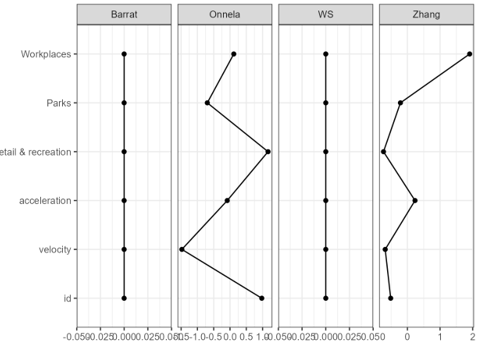
Fig. 2. Clustering of habitus mobility
The structuring analysis outlines the theoretical sequence of learning around mobility habitus (see Fig. 3). The assumption that mobility habitus is governed by a prevailing logic of violence and performativity of the dominant gender can be seen in the results, as the node referring to retail and recreation marks the beginning of the process, while the node corresponding to the workplace marks the end.
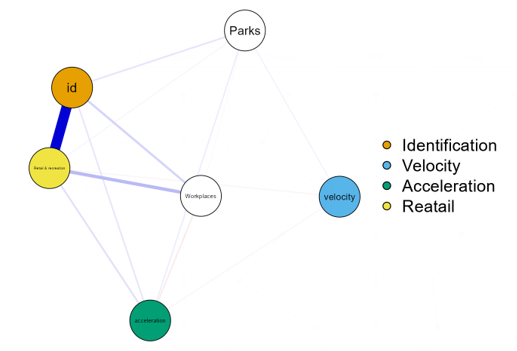
Fig. 3. Networks of habitus mobility
The centrality, grouping and structuring values suggest the rejection of the hypothesis consisting of the differences between the theoretical structure reported in the literature with respect to the structure observed in the surveyed sample.
Discussion
The contribution of this study to the state of the art lies in the establishment of a neural network that explains the learning sequence of the surveyed sample with respect to their mobility habitus, which begins with recreation and culminates with the workplace.
The network appears to model relationships between nodes labeled "Parks", "Workplaces", "Retail & Recreation", "Identification (id)", "Velocity", and "Acceleration". The nodes are connected by edges of different thickness, which could indicate the intensity or weight of the relationships between elements (Katz & Kahn, 1978).
From Contingency Theory the network reflects how components (places and concepts) interact to adapt to specific environments (DiMaggio & Powell, 1983). This may be applicable to urban planning, where "Velocity" and "Acceleration" could relate to mobility and productivity flows.
From Systems Theory the nodes and connections suggest an interdependent system. For example, "Workplaces" could be focused on interactions to optimize functions within the system (Mintzberg, 1993).
From Institutional Theory the node "Identification" could reflect institutional norms or structures that influence the connections between elements such as "Retail & Recreation" and "Parks" (Scott, 2003).
According to Manzi et al. (2020), connections in urban networks reflect how spatial and social dynamics impact human activities. The presence of nodes related to speed and acceleration is consistent with their findings on transportation and mobility.
Barabási (2016) argues that the thickness of connections in networks reflects centrality and relevance in information flows or interaction, which can be applied to the node “id” that appears to be a point of high connectivity.
Powell (1990) highlights that networks between organizations reflect cooperation and shared competencies. Here, nodes such as “Retail & Recreation” and “Workplaces” could represent synergies in retail and work environments.
The established neural network can serve to model and predict patterns of urban mobility or organizational behavior (Thompson, 1967). It helps to identify key nodes (such as “id” or “velocity”) and critical relationships that can guide planning or intervention strategies.
Without a clear explanatory framework, relationships could be interpreted ambiguously. The network does not consider external factors, such as public policies or demographic changes, that could alter connections.
It is recommended to incorporate demographic, economic or social data to enrich interpretations. Compare the model results with concrete case studies to validate the proposed connections. Further study nodes such as "id" and "velocity" to understand their influence on the network. Apply techniques such as deep learning to identify hidden patterns in more complex networks.
Conclusion
The aim of this work was to compare the observed neural network with the state-of-the-art structure where mobility habitus reflects a public transport system that is violent towards its users. In this sense, the results show some relationships that coincide with studies on mobility habitus, although the absence of variables related to mobility policies limits the results and their inclusion could anticipate scenarios of aggression in public transport.
References
- Adey, P. (2010). Mobility. Routledge.
View at Publisher | View at Google Scholar - Aggarwal, C. C. (2018). Neural Networks and Deep Learning: A Textbook. Springer.
View at Publisher | View at Google Scholar - Barabási, A.-L. (2016). Network Science. Cambridge University Press.
View at Publisher | View at Google Scholar - Bourdieu, P. (1977). Outline of a Theory of Practice. Cambridge University Press.
View at Publisher | View at Google Scholar - Bourdieu, P. (1990). The Logic of Practice. Stanford University Press.
View at Publisher | View at Google Scholar - Bourdieu, P. (2002). Esquisse pour une auto-analyse. Paris: Raisons d’Agir
View at Publisher | View at Google Scholar - Bustos, J. M., García, C. G., & Sandoval, F. (2021). Gobernanza y participación social en la gestión del agua. Análisis Regional, 16(1), 57–75.
View at Publisher | View at Google Scholar - Cravino, M. C. (2012). Las villas de la Ciudad: mercado e informalidad urbana. Buenos Aires: UNGS.
View at Publisher | View at Google Scholar - Cresswell, T. (2010). Towards a politics of mobility. Environment and Planning D: Society and Space, 28(1), 17–31.
View at Publisher | View at Google Scholar - DiMaggio, P. J., & Powell, W. W. (1983). The iron cage revisited: Institutional isomorphism and collective rationality in organizational fields. American Sociological Review, 48(2), 147–160.
View at Publisher | View at Google Scholar - García, C., Aguilar, J. A., Espinoza, F., Sandoval, F., Molina, J. C., & Bustos, J. M. (2016). Modelos de gobernanza del agua en universidades públicas. Gestión y Política Pública, 25(2), 385–410
View at Publisher | View at Google Scholar - Garzón, S. A., Bustos, J. M., & García, C. G. (2021). Gobernanza y capital humano en la sustentabilidad hídrica. Perspectivas Globales en Sostenibilidad, 7(3), 15–22.
View at Publisher | View at Google Scholar - Guillén, A. (2010). La construcción social de la ciudad: Espacio público, conflicto y participación. México: Siglo XXI.
View at Publisher | View at Google Scholar - Hanson, S. (2010). Gender and mobility: New approaches for informing sustainability. Gender, Place & Culture, 17(1), 5–23.
View at Publisher | View at Google Scholar - Haykin, S. (2009). Neural Networks and Learning Machines (3rd ed.). Pearson.
View at Publisher | View at Google Scholar - Jensen, O. B. (2009). Flows of meaning, cultures of movement: Urban mobility as meaningful everyday life practice. Mobilities, 4(1), 139–158.
View at Publisher | View at Google Scholar - Juárez, J., Bustos, J. M., & García, C. G. (2018). Gobernanza y percepción del riesgo ambiental en universidades públicas. Estudios Sociales, 26(52), 112–134.
View at Publisher | View at Google Scholar - Katz, D., & Kahn, R. L. (1978). The Social Psychology of Organizations (2nd ed.). Wiley.
View at Publisher | View at Google Scholar - Kaufmann, V., Bergman, M. M., & Joye, D. (2004). Motility: Mobility as capital. International Journal of Urban and Regional Research, 28(4), 745–756.
View at Publisher | View at Google Scholar - Lefebvre, H. (1974). La production de l'espace. Paris: Éditions Anthropos.
View at Publisher | View at Google Scholar - Llamas, J. J., Bustos, J. M., & García, C. G. (2018). Gobernanza del agua en la zona centro-sur de México. Revista Mexicana de Estudios Ambientales, 10(3), 123–139.
View at Publisher | View at Google Scholar - Manzi, G., Toppeta, F., & Vespignani, A. (2020). Urban mobility networks: Analyzing the interplay between human behavior and infrastructure. Journal of Urban Systems, 34(2), 235–256.
View at Publisher | View at Google Scholar - Mintzberg, H. (1993). Structure in Fives: Designing Effective Organizations. Prentice Hall.
View at Publisher | View at Google Scholar - Newman, M. E. J. (2010). Networks: An Introduction. Oxford University Press.
View at Publisher | View at Google Scholar - Paniagua, J. (2012). Territorio y poder: Elementos para una geografía política crítica. Madrid: Catarata.
View at Publisher | View at Google Scholar - Powell, W. W. (1990). Neither market nor hierarchy: Network forms of organization. Research in Organizational Behavior, 12, 295–336.
View at Publisher | View at Google Scholar - Rivera, F., Bustos, J. M., & García, C. G. (2018). Gobernanza y capital social en la gestión de recursos hídricos. Revista Iberoamericana de Gobernanza del Agua, 4(2), 45–58.
View at Publisher | View at Google Scholar - Sandoval, F., Molina, J. C., & García, C. G. (2021). Redes de gobernanza y percepción ambiental en universidades. Revista Mexicana de Sociología, 83(1), 115–136.
View at Publisher | View at Google Scholar - Schwanen, T., & Wang, D. (2014). Well-being, context, and everyday activities in space and time. Annals of the Association of American Geographers, 104(4), 833–851.
View at Publisher | View at Google Scholar - Scott, W. R. (2003). Organizations: Rational, Natural, and Open Systems (5th ed.). Pearson Education.
View at Publisher | View at Google Scholar - Sen, A. (2011). The Idea of Justice. Harvard University Press.
View at Publisher | View at Google Scholar - Sheller, M., & Urry, J. (2006). The new mobilities paradigm. Environment and Planning A, 38(2), 207–226.
View at Publisher | View at Google Scholar - Thompson, J. D. (1967). Organizations in Action: Social Science Bases of Administrative Theory. McGraw-Hill.
View at Publisher | View at Google Scholar - Urry, J. (2007). Mobilities. Polity Press.
View at Publisher | View at Google Scholar - Wasserman, S., & Faust, K. (1994). Social Network Analysis: Methods and Applications. Cambridge University Press.
View at Publisher | View at Google Scholar