 Clinic
Research | DOI: https://doi.org/10.31579/2835-9232/108
Perception About the Route of Attention in Health of Cancer in Patients of Envigado, 2020-2021
1 CES University
2 Secretariat of Health of Envigado
*Corresponding Author: Lilian Carolina Cifuentes Salinas, CES University, Argentina.
Citation: Lilian Carolina Cifuentes Salinas, Natalia Duque Zapata, Sergio Andrés Rodríguez Garzón, (2025), Perception About the Route of Attention in Health of Cancer in Patients of Envigado, 2020-2021, International Journal of Clinical Epidemiology, 4(6); DOI: 10.31579/2835-9232/108
Copyright: © 2025, Lilian Carolina Cifuentes Salinas, this is an open-access article distributed under the terms of the Creative Commons Attribution License, which permits unrestricted use, distribution, and reproduction in any medium, provided the original author and source are credited.
Received: 10 October 2025 | Accepted: 14 November 2025 | Published: 20 November 2025
Keywords: Cancer care facilities; neoplasms; quality of healthcare; health promotion; morbidity.Keywords: Cancer care facilities; neoplasms; quality of healthcare; health promotion; morbidity.
Abstract
Introduction: In Colombia, cancer represents the second cause of death for women and the third for men, in 2020 113,221 new cases of cancer were registered, been breast and prostate cancer the predomina- ting cause of morbidity and mortality.
Objective: Measure the patients perception about the health care route for cancer, from prevention to rehabilitation and palliative care.
Methods: descriptive cross-sectional observational study. A probabilistic sampling was carried out of the total care of cancer patients attended by outpatient consultation in Envigado during 2020. A questionnaire was applied integrating the Comprehensive Health Route (RIAS) Resolution 3280 of 2018 and the PE- CASUSS questionnaire. Absolute and relative frequencies were calculated for categorical variables and for mean continuouss and standard deviation.
Results: 43 adults with cancer were included, 70% were women with a mean age of 64 years (SD: 13), 44% attended elementary school and 70% were contributory regimen. 61% did not receive education on promotion and protection issues, 32% were not asked about risk factors and 70% did not receive screening. 91% said they were satisfied or very satisfied with the health care received.
Conclusions: the quality perceived by the patients on the cancer care route was good, with the treatment received by the healthcare personnel and the physical conditions being the best valued, however, the perception of education in prevention and care orientation received lower perception scores.
Introduction
Among chronic non-communicable diseases, he cancer is a high-cost disease with a major impact on families and communities due to the complexity of the treatments and complications. 1–3 This disease ha emerged as a A major health problem, it is the first or second leading cause of premature death (30–69 years) in more than 90 countries, affecting 1 in 8 men and 1 in 8 women. One in ten women are likely to develop the disease during their lifetime, associated with an estimated cost of cancer care of around $1.16 trillion per year. 4 The increasing magnitude of the burden of disease HE has to to a decrease of Fertility and increased life expectancy are factors, but changes in lifestyle and socioeconomic status in countries associated with globalization are also contributing to the increase in fertility and life expectancy. [4] In most countries with a development index human high, the rates of Cancer mortality rates are declining, while in countries in transition, mortality rates are still rising or stabilizing. 4,5 However, evolutionary change is also has manifested in changes in the distribution of cancer in these countries, in addition to the precarious implementation of the strategies of prevention and diagnosis they have generated a elderly burden of the disease, 4 it which has had repercussions on social and economic determinants and emotional of the communities. [1] In Colombia, cancer represents a growing public health problem; the country ranks sixth in cancer mortality. cancer after of Uruguay, Argentina, Chile and Brazil. Particularly in the last two decades the rate of mortality by cancer It tends to decrease, exhibiting minor fluctuations. and a discreet flattening of the trend in the last 5 years. 6 In Envigado the behavior of the event is similar to that recorded at the national level and in Antioquia, 7,8 whose main causes of death were malignant tumor of the trachea, bronchi and lung, colorectal tumor and stomach tumor, as they also occurred more frequently in the cycles population of childhood and adolescence the deaths by leukemia and, in adulthood and old age, he tumor malignant of the trachea. 9 In the decade 2010-2019, 1,438 new cases of cancer were registered for Envigado, with an average of 143 new cases per year. A cure for cancer is only possible for a small proportion of cases and It is closely related to diagnosis in early stages. Achieving the defined objectives depends so of the conditions under which the treatment is applied, such as quality of this, the availability of technologies, access to services, and timeliness in the delivery of therapeutic interventions. 1 Comprehensive care for cancer patients should be approached from a biological, psychological, familial, occupational, and social perspective, encompassing he diagnosis, he treatment and the patient's rehabilitation. 1 With the implementation of the Health Promotion and Maintenance Pathway (RPMS), seeks recruitment of all the population by half of the implementation of promotional actions and prevention in each cycle of life, with he in order to guarantee the right to health and the integral development of individuals, families and communities through various actions, including that HE stands out the ID timely of vulnerabilities, risk factors, accumulated risks, and alterations that emerge at each stage of life. 10 The objective of The present study was to measure the perception of patients about the Cancer health care pathway, from prevention to rehabilitation and palliative care.
Materials and methods
Cross-sectional observational study with a quantitative approach. It was approved by the Committee Institutional of Ethics in Investigation in Beings Humans of the University CES, through Act No. 177, considered as an investigation without risk according to the Resolution 8430 of 1993, from the Ministry of Health.
Subjects of study
The patient population consisted of 884 people with a diagnostic impression, diagnosis confirmed new either confirmed repeated cancer diagnoses that were seen in the clinic external in the different Healthcare Provider Institutions (IPS) in the municipality of Envigado (Colombia) during the year 2020 that met the eligibility criteria. These were being 18 years of age or older, being caregivers of people with disability either with apparent cognitive impairment, residents of Envigado, and with a diagnostic impression, new confirmed diagnosis, or repeated confirmed diagnosis of: malignant tumor or melanoma of the skin, malignant tumors of the male genital organs, malignant tumor of the small intestine, colon, rectum, and anus, malignant tumor of the breast, malignant tumor of the larynx, trachea, bronchi, and lung, malignant tumor of the esophagus and stomach, malignant tumors of the female genital organs, malignant tumor of the thyroid and other endocrine glands, or malignant tumor of poorly defined sites and other unspecified sites. These types of tumors represent 80% of the cancer incidence in Envigado. 9 The exclusion criteria were apparent cognitive impairment, lack of desire of participate in he study and No participation in the Cancer Care Pathway.
Procedures
A probabilistic sampling was performed on the total number patients attended through the Records Individual Service Provision Health (RIPS) of 2020; HE established a 95% confidence level, 5% error, and a prevalence of the 97 % (satisfaction global of the users in the IPS of Antioquia for the period 12-2020), 11 obtaining a size A sample of 43 patients was surveyed. sampling random simple in he that All related patients were listed in the RIPS 2020 in a unique and accurate manner. with diagnosis of impression diagnostic, newly confirmed or repeated confirmed for cancer. Subsequently, participants were selected through the generation of random numbers with the Epidat 3.1 program.
For data collection, telephone surveys were conducted with an average time of 20 minutes per survey (minimum 7 and maximum 44). Informed consent was used, guaranteeing complete confidentiality of The data provided. Potential information and selection biases were identified, and their controls were established. Sociodemographic data and of perception HE The data collected from the interviews, based on the prepared questionnaire, included: age, gender, education, marital status, social security system, and IPS (Health Service Provider). of attention, main occupation, area of residence, specific questions for the application of RIAS and the PECASUSS instrument.
Instruments
A questionnaire was developed to assess perception of the patients with cancer about the application of the RIAS, Resolution 3280 of 2018, 10 and the Health Services Users' Perception of Quality questionnaire (PECASUSS). In the case of RIAS, aspects related to with the promotion of conditions and styles of life healthy, prevention of the cancer, strategies of demand induced, screening and interventions for management, treatment, rehabilitation and palliation.
He PECASUS is a instrument designed to measure the quality of healthcare perceived by the user. It was validated in Colombia by the Ministry of Health and Protection Social; 12–14 It has 29 questions, including closed-ended answers. and two open. Between the variables The following are evaluated: accessibility, effectiveness, infrastructure conditions, timeliness, continuity and coordination, adherence to the institution, and opinions on elements to be improved within it.
Analysis statistical
He analysis univariate HE applied For the description of sociodemographic and perceptual characteristics, absolute and relative frequencies were used for categorical variables, and means and standard deviations for quantitative variables if the distribution was normal; otherwise, medians and interquartile ranges (IQR) were used. The program used was Microsoft Excel. was employee for he storage of data and all statistical analyses.
Results
Of a total of 884 people who were in the RIPS records, 43 adults diagnosed with cancer who met the criteria were included. criteria of eligibility. He 70 % corresponded to women with an average age of 64 years (SD:13 years), he 44 % of the patients had a level educational of basic primary and he 70?longed to the contributory scheme. Other sociodemographic characteristics are present in the Board 1.
| Characteristics * | Female (n=30; 70 %) | Male (n=13; 30 %) | Total (n=43) | |||
| Cluster of age | n | % | n | % | n | % |
| 25-29 years | - | 0.0 | 1 | 7.7 | 1 | 23 |
| 30-34 years | 2 | 6.7 | - | 0.0 | 2 | 4.7 |
| 35-39 years | 1 | 3.3 | - | 0.0 | 1 | 23 |
| 50-54 years | 4 | 13.3 | - | 0.0 | 4 | 9.3 |
| 55-59 years | 3 | 10.0 | 1 | 7.7 | 4 | 9.3 |
| 60-64 years | 3 | 10.0 | 3 | 23.1 | 6 | 14.0 |
| 65-69 years | 7 | 23.3 | 1 | 7.7 | 8 | 18.6 |
| 70-74 years | 3 | 10.0 | 4 | 30.8 | 7 | 16.3 |
| 75-79 years | 3 | 10.0 | 2 | 15.4 | 5 | 11.6 |
| 80-84 years | 4 | 13.3 | 1 | 7.7 | 5 | 11.6 |
| Level educational | ||||||
| Primary | 12 | 40.0 | 7 | 53.8 | 19 | 44.2 |
| Secondary | 7 | 23.3 | 2 | 15.4 | 9 | 20.9 |
| Technique | 6 | 20.0 | 3 | 23.1 | 9 | 20.9 |
| University | 5 | 16.7 | - | 0.0 | 5 | 11.6 |
| None | - | 0.0 | 1 | 7.7 | 1 | 23 |
| Occupation major | ||||||
| Home | 15 | 50.0 | 3 | 23.1 | 18 | 41.9 |
| Pensioner | 7 | 23.3 | 4 | 30.8 | 11 | 25.6 |
| Job | 5 | 16.7 | 2 | 15.4 | 7 | 16.3 |
| Unemployed | - | 0.0 | 4 | 30.8 | 4 | 9.3 |
| Home and work | 2 | 6.7 | - | 0.0 | 2 | 4.7 |
| Home, job and study | 1 | 3.3 | - | 0.0 | 1 | 23 |
| Regime of Security Social | ||||||
| Contributory | 22 | 73.3 | 8 | 61.5 | 30 | 69.8 |
| Subsidized | 4 | 13.3 | 5 | 38.5 | 9 | 20.9 |
| No affiliate | 1 | 3.3 | - | 0.0 | 1 | 23 |
| Regime special** | 3 | 10.0 | - | 0.0 | 3 | 7.0 |
| State civil | ||||||
| Married | 13 | 43.3 | 10 | 76.9 | 23 | 53.5 |
| Single | 9 | 30.0 | 1 | 7.7 | 10 | 23.3 |
| Widower | 5 | 16.7 | 1 | 7.7 | 6 | 14.0 |
| Separate | 2 | 6.7 | - | 0.0 | 2 | 4.7 |
| Union Free | 1 | 3.3 | 1 | 7.7 | 2 | 4.7 |
| Area of residence | ||||||
| 09 | 6 | 20.0 | 4 | 30.8 | 10 | 23.3 |
| 06 | 5 | 16.7 | 3 | 23.1 | 10 | 23.3 |
| 07 | 7 | 23.3 | - | 0.0 | 8 | 18.6 |
| 08 | 2 | 6.7 | 1 | 7.7 | 7 | 16.3 |
| 03 | 2 | 6.7 | 1 | 7.7 | 3 | 7.0 |
| 05 | 2 | 6.7 | 0.0 | 3 | 7.0 | |
| Without information | 6 | 20.0 | 4 | 30.8 | 2 | 47 |
Table 1: Sociodemographic characteristics of cancer patients treated in outpatient clinics in Envigado, 2020
Grades:
* Results survey Perception of patients about the Route of attention in health in Cancer, Envigado; creation own.
** Police, military forces, teachers.
61% of patients reported not receiving education I communication by part of the IPS, EPS either the Secretariat of health territorial in Topics related to promoting healthy conditions and lifestyles (Figure 1). 84% of patients reported have either have had cancer to the moment Of the measurement, 32% had malignant breast tumors, he 19 % with tumors malignant of male genital organs and 2.7% with tumor or melanoma malignant of the fur, tumor malignant of the bladder, kidney, ureter and others organs urinals.
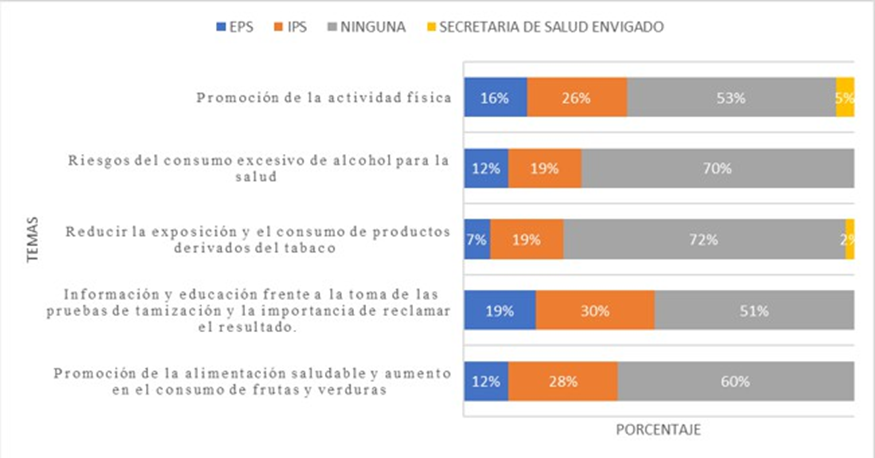
Figure 1: Proportion of education and communication for the health in cancer taught according to institution
Note: Survey Perception of patients about the Route of attention in health in Cancer, Envigado; original creation.
To the 32 % of the patients No HE you asked due to factors of risk related with cancer And 70% did not undergo screening tests, because the consultation was due to the presence of symptoms. 84% of the tests performed according to the identified risk had an abnormal result, of which 95% were managed. (77 % remission to specialist, 14% new diagnostic aids, 5% referral to medicine general). He 70 % of the patients It was part of the care, recovery and overcoming service (Treatment). 58% of patients reported not having received an assessment from the multidisciplinary team: nutrition, palliative care, rehabilitation, mental health and/or social work; meanwhile, 84% considered that the administrative process of their EPS in relation to the authorizations was timely.
Ninety-one percent of patients reported being satisfied (56%) or very satisfied (35%) with the healthcare they received (Table 2). They also rated the quality of service received with a median of 5 (IQR: 1) (Table 3).
Did the care you received at the private IPS Total institution leave you satisfied ? * other public high IPS general S&M complexity | ||||||||||
n | % | N | % | n | % | n | % | n | % | |
| Satisfied | 4 | 80 | 9 | 75 | 5 | 29 | 6 | 67 | 24 | 56 |
| Very satisfied | 1 | 20 | 3 | 25 | 10 | 59 | 1 | 11 | 15 | 35 |
| Neither dissatisfied neither satisfied | - | 0 | - | 0 | 1 | 6 | 2 | 22 | 3 | 7 |
| Very dissatisfied | - | 0 | - | 0 | 1 | 6 | - | 0 | 1 | 2 |
Table 2: Distribution of the satisfaction in the attention of the patients with cancer attended in Envigado, 2020
* Survey Perception of patients about the Route of attention in health in Cancer, Envigado.
| Questions* n | % | |||
| He procedure thatdid for be attended todayeither he day that incometo the institution, you It seemed. | ||||
| Single 26 | 60% | |||
| Neither complicated neither single 8 | 19% | |||
| Very simple 5 | 12% | |||
| Very complicated 3 | 7% | |||
| Complicated 1 | 2% | |||
| Yeah had that pay by something for be attended (to), this pay It seemed to him: |
| |||
| No applies 34 | 79% | |||
| Cheap 4 | 9% | |||
| Neither expensive neither cheap 4 | 9% | |||
| Very cheap 1 | 2% | |||
| He time from thatarrive to emergency room, to achieve eitherask a appointment, until thatit (to) |
| |||
| they attended was of: (Answer) in minutes) |
| |||
| Neither long nor short 19 | 44% | |||
| 30 3 | 7% | |||
| 10 2 | 5% | |||
| 15 1 | 2% | |||
| 20 1 | 2% | |||
| 30 6 | 14% | |||
| 40 2 | 5% | |||
| 60 4 | 9% | |||
| Short 11 | 26% | |||
| 10 3 | 7% | |||
| 15 2 | 5% | |||
| 20 2 | 5% | |||
| 30 3 | 7% | |||
| 5 | 1 | 2% | ||
| Long | 8 | 19% | ||
| 30 | 1 | 2% | ||
| 40 | 2 | 5% | ||
| 60 | 5 | 12% | ||
| Very long | 5 | 12% | ||
| 180 | 1 | 2% | ||
| 30 | 1 | 2% | ||
| 90 | 3 | 7% | ||
| The solution thatyou they gave to the needof health by the thatconsulted this institution and hospital | ||||
| youIt seemed: | ||||
| Good 24 56% | ||||
| Very good 16 37% | ||||
| Bad 1 2% | ||||
| Very bad 1 2% | ||||
| Neither bad neither good 1 2% | ||||
| The answersof the staff of the institution in view of their concerns either questions you They appeared to be: | ||||
| Appropriate 32 74% | ||||
| Very appropriate 8 19% | ||||
| Neither appropriate nor inappropriate 2 5% | ||||
| Inappropriate 1 2% | ||||
He restroom of the institution It seemed to him: |
| |||
Well | 22 | 51% | ||
Very good | 19 | 44% | ||
Neither bad neither Well | 2 | 5% | ||
The plantphysics be he building of the institution you It seemed: |
| |||
Careful | 19 | 44% | ||
Very careful | 18 | 42% | ||
Neither careless neither careful | 4 | 9% | ||
Careless | 1 | 2% | ||
Very careless | 1 | 2% | ||
| Therooms wait, the chairs, the beds and stretchers, if saw them or the use, how They seemed to him to be: | ||||
| Comfortable 39 91% | ||||
| Neither uncomfortable nor comfortable 2 5% | ||||
| Uncomfortable 1 2% | ||||
| Very uncomfortable 1 2% | ||||
He deal that received of doctors, nursesand others professionals of health you It seemed: | ||||
Very good | 23 | 53% | ||
Well | 18 | 42% | ||
Well | 28 | 65% | ||
Very good | 11 | 26% | ||
Neither bad neither Well | 3 | 7% | ||
| Bad | 1 | 2% | ||
| The cooperation between officials of the institution (either of institutions) in view of his needof attention was: | ||||
Good | 25 | 58% | ||
Very good | 14 | 33% | ||
Neither bad neither good | 3 | 7% | ||
Bad | 1 | 2% | ||
The ability of the professionals for solve his need of health It seemed to him: |
| |||
High | 26 | 60% | ||
Very high | 12 | 28% | ||
Neither low neither high | 4 | 9% | ||
Low | 1 | 2% | ||
The orientation that received in the institution for make careof his healthin home |
| |||
you It seemed: |
| |||
Enough | 21 | 49% | ||
Very enough | 11 | 26% | ||
Neither insufficient neither enough | 6 | 14% | ||
Insufficient | 4 | 9% | ||
From zero(Appalling) until five(Excellent), with how much would rate the quality of the service |
|
| ||
received? |
|
| ||
5 | 22 | 51% | ||
4 | 18 | 42% | ||
2 | 2 | 5% | ||
3 | 1 | 2% | ||
The attention received in the institution it let in general: |
|
| ||
Satisfied | 24 | 56% | ||
Very satisfied | 15 | 35% | ||
Neither dissatisfied neither satisfied | 3 | 7% | ||
Very dissatisfied | 1 | 2% | ||
Would I go back to the Hospital? Yes No |
42 1 |
98% 2% | ||
Table 3: Description of the quality of care perceived by patients treated in Envigado, 2020 (Questionnaire PECASUSS)
* Survey Perception of patients about the Route of attention in health in Cancer, Envigado.
The average waiting time to receive care in health was of 30 minutes (RIC: 75-25), with variations between 5 and 180 minutes; 46.5% of patients waited from 11 to 30 minutes. 44% of patients did not perceive the waiting time as either short or long, while 31% of patients it considered long either very long. According to the physical condition of the institution, 44% of patients reported that they received good care, while 4% reported that they received neglected or very neglected care; 91% rated the common areas of the healthcare provider as comfortable. Similarly, patients highlighted positive aspects such as helpfulness (88%) and the quality of care provided. by the professionals of the health (95 %); he 98 % he stated the intention of return to the IPS. The results of the PECASUSS questionnaire are described in Table 3. 53.4% of patients suggested aspects to improve in the healthcare providers, including: reduction of time for the attention time elapsed between requesting an appointment and receiving actual care, reduce administrative procedures, increase the presence of healthcare staff and administrative staff in healthcare providers (mainly general practitioners, specialists and user service personnel), infrastructure improvements (expansion of spaces), increase endowment in areas of wait, humanization of the services, improve the availability of medicines and the timeliness of delivery/administration.
Discussion
The cancer patients in this study are married women over 60 years of age. and with basic primary as level of education reached. The most of The patients reside in zones 6, 7, and 9, consistent with the findings reported in the study of cancer incidence and mortality in Envigado. These results were also observed in the description of the municipality's health situation: the largest proportion of the population is of sex female, HE reports a progressive aging with population increase adult and a notorious decrease of the child and adolescent population, with a greater concentration of the elderly population 60 years in the same zones reported by this study. 8 For their part, marital status and level of education play a relevant role in the evolution of the disease. In a A study of chronic non-communicable diseases found that for diabetic patients, 15 The level of education was linked as a key determinant of mortality. in both sexes, since as the level of education decreases, the risk of death increases in women; for men, being single was attributed to a higher mortality rate. 15 Health education and communication is a strategic action that aims to create a cultural climate for health promotion and quality of life, contributing to the construction of other ways of understanding and caring for health, enhancing attitudes such as self-care and empowerment; the above, is a responsibility of all the actors of the Social Security System in Health (SGSSS). In Envigado HE they have gone deploying shares health education in different environments (home, school, work environment, public space ) to through of the plan of development and of Each of its strategic lines, 16 likewise, the insured and providers have programs of education and communication for health of the different services offered. 17–20 In this study HE evidence that great percentage patients are unaware of the different means to the education and communication that HE They have [the following information - likely a separate, unrelated section:] EPS, IPS and territorial entities. The above can be explained by factors such as: gaps in the measurement of coverage indicators and plan implementation. 21 It is worth noting that one third of cancer deaths are due to behavioral risk factors. and dietary as: index of mass High body mass index, reduced intake of fruits and vegetables, lack of physical activity, tobacco use and consumption of alcohol; for Colombia, are added factors as level socioeconomic factors, occupational exposures and infections.1,22 In the results obtained, 32% of the patients reported a lack of investigation of risk factors attributable to cancer and the indications related to promotion and protection. Results similar HE observed in a study conducted in Barranquilla, Colombia, in he that HE I was looking determine Knowledge, activities and barriers in primary health care for professionals nursing in he level of attention basic. It was observed that 65% of the people evaluated had a knowledge No acceptable with in relation to primary health care policies; 23 consequently, the need arises to identify which are the factors and barriers that affect the provision of health services. 24 TO to start of the implementation of the Health Promotion and Maintenance Route carried out in 2018 , 10 recommends the recruitment of all the population by half of the implementation of promotional actions and prevention in each cycle of life, with he in order to guarantee the right to health and the integral development of individuals, families and communities through various actions, including that HE stands out the ID timely of vulnerabilities, risk factors, accumulated risks, and alterations that emerge in each moment vital. Starting of this First, the study observed that 7 out of 10 patients No they had demand induced to medical services, since they accessed medical care due to the presence of symptoms; this condition can be reflected in the decrease in coverage in the different health care programs, as well as the limited access of patients to tests of screening for several guys of cancer such as breast and cervix. 25,26 According to the matrix of the RIAS of the cluster of risk cancer, a program of medium oncology HE integrates by he A set of services aimed at the recovery of an activity or function lost or diminished due to cancer, which includes palliative care, nutrition, rehabilitation, psychology, psychiatry, etc., which can be provided to the patient at any stage of the process of Attention. 10 The The results indicate that the largest proportion of patients he stated No receive none attention from this group of professionals, indicating a lack of coordination between the different services (prevention, early detection and medical assistance) and provider networks; in this way, the efforts of each institution are isolated and No HE can achieve he Expected impact . 1,27,28 Various studies highlight the need of redesign he concept of service oncology under the approach of comprehensive care and the importance of enabling functional units, comprehensive treatment centers and other forms of care. 28 The timeliness of medical care means that no patient will have to wait longer than time reasonable about the healthcare operations, according to needs. Technical opportunity refers to access, that is, the use of services, within a range of time within which the care provided could be effective. 29 In Antioquia in the year 2017 he time half of wait for he start The treatment time was three days, classified as a short or very short waiting time. 29 The results of this study were similar; 86% of patients reported the administrative process of their EPS as timely; however, the data obtained No allow carry out specific analysis of opportunity in care. The quality of attention in health perceived by the user seeks measure aspects as: provision of information, ability to choose, administrative management, lodging, continuity of the care between levels of care, and others; that is to say that the relationship between the quality measurable and the observed by he patient, must be views like a gear of continuous improvement. 30 The results obtained in the study show that he 91 % of the patients refers to that the Issues related to service accessibility, such as the various procedures involved, are neither complicated neither neither very simple; These results have been reported by different authors. 12,13,13,14,31 According to overall satisfaction in Colombia for he period of 2016 HE obtained a value of 91.46%; 32 for Envigado this study reported a similar result, finding an overall health satisfaction of 91%. Currently, there is little scientific evidence related to the perception of the quality of care in cancer; however, the perception of quality in general health has been studied by various authors. 14,31,33,34 These findings suggest the possibility of searching strategies additional for the Proper implementation of Integrated Healthcare Services (IHSS) in cancer, as well as the continuous improvement of health services, are crucial. Clinical and psychosocial support has a significant impact on cancer patients, contributing significantly to their well-being. the conditions of life and adaptability of the condition of health. This study serves to preceding for carry out explorations of the factors to level of insurance and of provision, which affect the positive or negative perception of the quality of care received by cancer patients. The major limitations of the present study were: the sample size, which prevented an exploratory analysis with other variables in search of association with factors specific that would contribute to patients' poor perception of quality of the services of health; he access to the participants' contacts, given that different means of contact were used, and in a high percentage No were effective by lack of availability and the scarce evidence Scientific research related to studies of perceived quality of care in cancer. Another aspect presented was that, during the realization of In the surveys, cases were identified of patients who were unaware of the cancer diagnosis or reported not having it; this bias was controlled through double verification in databases .
Conclusion
The quality perceived by patients regarding the Route of attention in cancer was good, the treatment received from the healthcare staff and Physical conditions received the best ratings; however, perceptions of education in prevention and care guidance received lower perception scores. results evidence failures in the Patient recruitment processes by EPSs for the development of health promotion and maintenance activities, as well as barriers in the processes internal of adherence to clinical practice guidelines and RIAS for cancer.
Aspects ethical
The researchers adhere to the 2013 Declaration of Helsinki and the Scientific, Technical and Administrative Standards for Research in Health of the Resolution 008430 of October 4, 1993 from the Ministry of Health of the Republic of Colombia, in the which It is classified as a risk-free investigation. It was used consent informed guaranteeing complete confidentiality of the data provided; the study was approved by the Institutional Ethics Committee for Research in Human Beings of the CES University, through Act No. 177.
Fountain of Financing
Research funded by the Mayor's Office of Envigado, with supervision from the Envigado Health Secretariat.
Conflicts of interest
The information described is part of the report. of "Consultancy for the realization "of diagnoses and measurement of indicators on topics of interest in public health, which help in the recognition of health conditions, care challenges and the generation of health action plans in the municipality of Envigado" between the Envigado Health Secretariat and CES University, Service provision contract ENV-13-30-1088-21.
Acknowledgments
The authors thank the people with cancer who agreed to participate in the study.
Collaborations
Lilian Carolina Cifuentes contributed to the conception and design of the study, the acquisition, analysis and interpretation of the results and in the writing and critical revision of the manuscript.
Natalia Duque contributed to the writing and critical review of the manuscript.
Sergio Andrés Rodríguez contributed to the acquisition and analysis of the results.
Biography of the authors
Lilian Carolina Cifuentes. Nurse, Specialist in Epidemiology.
Natalia Duke. Nurse, Master's degree in Epidemiology and Master in Management of Knowledge.
Sergio Andrés Rodríguez. Information Systems Manager.
References
- cancer in Colombia, 2012-2021 [ISnternet]. Bogotá, 2012. Available from: https://www.minsalud.gov.co/ Documents/Plan-Decenal-Cancer/PlanDecenal_ ControlCancer_2012-2021.pdf
View at Publisher | View at Google Scholar - Ministry of Health and Protection Social. Ten-Year Public Health Plan 2012-2021 [Internet]. Bogotá, 2012. Available from: https://www.minsalud.gov.co/sites/rid/Lists/ BibliotecaDigital/RIDE/VS/ED/PSP/PDSP.pdf
View at Publisher | View at Google Scholar - Gil F, De Vries E, Wiesner C. Importance of access of population-based cancer registries to vital statistics: barriers identified in Colombia. Rev Colomb Cancerol [Internet]. 2019;23:56-61. Available from: https://doi.org/10.35509/01239015.60
View at Publisher | View at Google Scholar - Wild C, Weiderpass E, Stewart B. World Cancer Report: Cancer Research for Cancer Prevention. International Agency for Research on Cancer; 2020.
View at Publisher | View at Google Scholar - de Vries E, Arroyave I, Pardo C, et al. Trends in inequalities in premature cancer mortality by educational level in Colombia, 1998–2007 [Internet]. 2007. Disponible en: https://doi. org/10.1136/jech-2014-204650
View at Publisher | View at Google Scholar - Ministry of Health and Social Protection. Incidence of the cancer HE reduced in the last
View at Publisher | View at Google Scholar - 3 years. Press release No. 158 of 2021 [Internet]. 2021. Available from: https://www. minsalud.gov.co/Paginas/Incidencia-del-cancer-se-redujo-en-los-ultimos-3-anos.aspx
View at Publisher | View at Google Scholar - Governor's Office of Antioquia. Analysis of the health situation, 2020 Update [Internet]. 2020. Available in: https:// www.dssa.gov .co/images/asis/ASIS_ ANTIOQUIA_2020_VERSION_II.pdf
View at Publisher | View at Google Scholar - Situation of health municipal, Envigado, 2020. [Internet]. 2020. Available from: https://www.envigado.gov.co/secretaria- health/SiteAssets/010_ACORDE ONE S/ DOCUMENTOS/2021/08/Situation%CC%81n%20 de%20Salud%202019%20.pdf
View at Publisher | View at Google Scholar - CES University, Envigado Health Department. Cancer incidence and mortality in Envigado, 2010-2020.
View at Publisher | View at Google Scholar - Ministry of Health and Social Protection. Resolution 3280 of 2018. [Internet]. 2018. Available from: https://www.minsalud.gov.co/ New Regulations/Resolution No.%203280%20de%2020183280.pdf
View at Publisher | View at Google Scholar - Ministry of Health and Protection Social, SISPRO. Indicators Resolution 256 of 2016 [Internet]. 2020. Available from: http://rssvr2.sispro.gov. co/IndicadoresMOCA/Resolucion256- 2016.aspx
View at Publisher | View at Google Scholar - Ministry of Health and Social Protection. Perception of Quality [Internet]. 2009. Available from: https://es.calameo.com/ books/0001482485b58ae03fe68
View at Publisher | View at Google Scholar - Cabrera G, Londoño J, Lion Beautiful. Validation of an Instrument to Measure Perceived Quality by Users of Hospitals of Colombia. Rev Salud Pública. [Internet]. 2008:443-451. Available from: https://doi.org/10.1590/S0124- 00642008000300009
View at Publisher | View at Google Scholar - Cabrera GA, Bello LD, Londoño JL. Quality Perceived by Users of Hospitals in the Program of Restructuring of Networks of Services of Health of Colombia. Rev Public Health [Internet]. 2008:593-604. Available from: https://doi.org/10.1590/S0124- 00642008000400009
View at Publisher | View at Google Scholar - Escolar-Pujolar TO, Mrs ALREADY, Goicolea J, et al. The effect of marital status on social and gender inequalities in diabetes mortality in Andalusia [Internet]. 2018. Available at: https://doi. org/10.1016/j.endinu.2017.10.006
View at Publisher | View at Google Scholar - Town hall of Envigado. Plan of development 2020-2023 Together we add up for Envigado [Internet], 2020. Available at: https:// www.concejoenvigado.gov.co/wp-content/ Development -Plan.pdf
View at Publisher | View at Google Scholar - THAT Hospital Manuel Uribe Angel. Services of low complexity [Internet]. 2021. Available at: https://www.hospitalmua. gov.co/Atencionserviciosciudadania/Paginas/ Institution-friendly-to-women-and-children. aspx
View at Publisher | View at Google Scholar - Antioquia Cancer Center. [Internet]. 2021. Available at: https://coa.com.co/
View at Publisher | View at Google Scholar - EPS Sura Health Guidance Service [Internet]. 2021. Available from: https://www. epssura.com/test
View at Publisher | View at Google Scholar - Programs of promotion and prevention Nueva EPS [Internet]. 2021. Available from: https://www.nuevaeps.com.co/programas- promotion-prevention
View at Publisher | View at Google Scholar - PAHO, WHO. Concepts and guide for impact analysis in health for the Region of the Americas [Internet]. 2013. Available from: https://www. paho.org/hq/dmdocuments/2013/evaluation- impact-2013.pdf
View at Publisher | View at Google Scholar - WHO. Cancer. [Internet]. 2018. Available at: https://www.who.int/es/news-room/fact- sheets/detail/cancer
View at Publisher | View at Google Scholar - Bruno Rubio V, Bustamante Llinás MJ, Jiménez Hamburgen A, Maldonado Mendoza L, Segura Barrios I, Tuesca Molina R. Primary Care In Health. A look from the professionals Nursing: Barriers, knowledge, and activities. Barranquilla (Colombia). Salud Uninorte [Internet]. 2015;31(2):295-308. Available from: http://dx.doi.org/10.14482/ sun.30.1.4309
View at Publisher | View at Google Scholar - Martins Bertocchi F, Fernandes BM, Gomes de Almeida MI, et al. Conduct of professionals during the consultation of Tracking of Breast and uterine cancer. [Internet]. 2014;15. Available at: http://dx.doi.org/10.15253/2175- 783.2014000600010
View at Publisher | View at Google Scholar - National Observatory of Mental Health. Mental Health Component [Internet]. 2019. Available from: http://rssvr2.sispro.gov.co/ ObsSaludMental/
View at Publisher | View at Google Scholar - National Cancer Observatory. Early detection. [Internet]. 2019. Available from: https://www.sispro.gov.co/observatorios/ oncancer/indicators/Pages/detection- early.aspx
View at Publisher | View at Google Scholar - Ministry of Health, National Cancer Institute. Bulletin of Oncological Services, 2019. [Internet]. 2019. Available from: https:// www.cancer.gov.co/recursos_user/files/libros/ files/2019.Services%20Bulletin Oncol%C3%B3gicos%20v1.0
View at Publisher | View at Google Scholar - Murcia E, Aguilera J, Wiesner C, Pardo C. Oncology services in Colombia. Colombia Médica [Internet]. 2018;49:89-96. Available in: https://doi.org/10.25100/cm.v49i1.3620
View at Publisher | View at Google Scholar - Ministry of Health and Social Protection. Results Report: Survey on the Evaluation of EPS Services. [Internet]. 2017. Available from: https://www.minsalud.gov.co/ sites/rid/Lists/BibliotecaDigital/RIDE/DE/CA/ viewer-survey-satisfaction-eps-2017.pdf
View at Publisher | View at Google Scholar - Ross AG, Zeballos JL, Infante A. Quality and reform of the sector of the health in America Latin America and the Caribbean. Rev Panam Salud Pública [Internet]. 2000;8(1):93-98. Available from: https://iris.paho. org/bitstream/handle/10665.2/8793/3007. pdf?sequence=1&isAllowed=y
View at Publisher | View at Google Scholar - Chacón Straw J, Bedoya Florez CX, Noguera Velasco LF. Perception of the quality of care in health, in users of the service Outpatient consultation, from the IPS Horisoes in the municipality of Florencia, Caquetá in the last quarter of 2018 [Internet]. 2019. Available from: https://repository.universidadean.edu.co/ handle/10882/9629
View at Publisher | View at Google Scholar - Ministry of Health and Social Protection. Report National of Quality in Health Incas 2017. [Internet]. 2017. Available at: https://www.minsalud.gov.co/sites/rid/ Lists/BibliotecaDigital/RIDE/DE/CA/report- national-quality-health-incas-2017.pdf
View at Publisher | View at Google Scholar - Parra EJ, González Bohórquez SJ. Perceived quality by users of the service of Emergency room, General Hospital of Medellín, Colombia 2010. [Internet] 2010. Available in : h t t p s : //www. h g m . g either v. c either /l either to right downloads&lFunction=download&idFile=840
View at Publisher | View at Google Scholar - Yépez Chamorro MC, et al. Perceived quality of health care in a public network in the municipality of Pasto, Colombia. University and Health [Internet] 2018;20(2):97-110. Available from: https://doi.org/10.22267/rus.182002.114
View at Publisher | View at Google Scholar